
APHA 2025 FINAL PROGRAM
Click here to view as a PDF
Released: August 8, 2025 (updated: October 29, 2025)
At a time when public health & health equity & social justice are under attack by the US federal government, the Spirit of 1848 is grateful to share our final program / 1-page flyer for the American Public Health Association’s 153rd Annual Meeting and Expo, November 2-5, 2025, to be held in Washington, DC. We can proudly state that every session features presenters willing to speak up and be in solidarity in these dangerous times. When we came up with our theme last fall, “Making Health Justice: Everything Everywhere All at Once,” which we decided upon in the aftermath of the November 2024 elections, we sensed but had no idea how apt this theme would be – capturing both the all-sided attacks on what we value & stand & work for AND the all-sided powerful responses by advocates for social justice & public health. The links to the sessions are as follows:
Link to 1848 sessions: https://apha.confex.com/apha/2025/meetingapp.cgi/Program/2593
Link to overall APHA program: https://apha.confex.com/apha/2025/meetingapp.cgi/Home/0
The official theme for the American Public Health Association (APHA) annual meeting in 2025 is: “Making the Public’s Health a National Priority” – and we applaud APHA for having the courage, on April 10, 2025, to call for RFK Jr either to resign or be fired from his position in charge of the US Department of Health and Human Services, stating bluntly that “Senator Kennedy and his policies are a danger to the public’s health” – and we also applaud APHA for stepping up to be a plaintiff on myriad lawsuits seeking to stem and overturn these harms (see the different lawsuits listed at the page: https://apha.org/news-and-media/news-releases).
For the Spirit of 1848, we once again offer a variant of this theme, informed by our longstanding approach to grounding present-day struggles for health justice in the histories of our field and in the principles of solidarity and bolstering critical analysis and action for fostering inspiring, equitable, sustainable, joyful, and dignified futures for all. Hence our theme, which is core to the mission of the Spirit of 1848 Caucus:
“Making Health Justice: Everything Everywhere All at Once,”
We list below the final program for our sessions—along with our two special events! – and we look forward to joining together in Washington, DC where we can together bolster our spirits as we move forward the work for health justice.
The two special events (above and beyond our usual Spirit of 1848 sessions) are as follows:
(1) “Attacks on Science and the Public’s Health: How We Are Fighting Back” – Panel Discussion (Sunday, Nov 2, 2025, 2:30 to 4:00 pm; Session 2104.0, Location: Washington Convention Center (WCC), Room 152A), a collaborative session co-organized by SCAPHA & the Spirit of 1848 Caucus
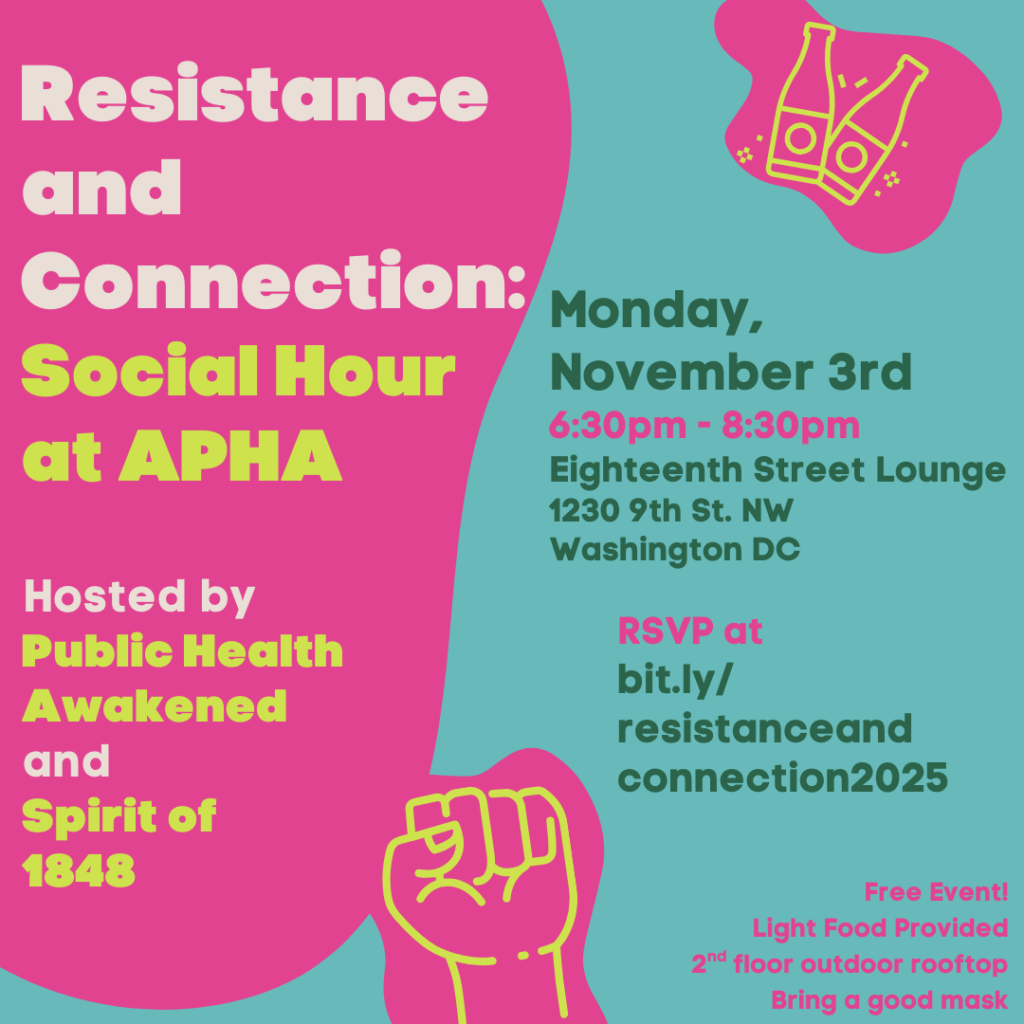
(2) “Resistance & Refreshment” Social Hour (Monday, Nov 3, 6:30 – 8:30 pm; Location: 18th St Lounge, 1230 9th St NW – a 5 min walk from the convention center!), happily co-organized once again with Public Health Awakened, a tradition we started back in 2019— and we very much look forward to having our 6th joint social hour this fall!!!! – here is the RSVP link & also a link to the 18th St Lounge website!
Note: because of the Sunday event we are co-organizing with SCAPHA, the Spirit of 1848 will *not* additionally be organizing a Radical History tour this year. We recognize, however, that accurate accounts of the social history of the US, including the social history of public health, are under attack by the Trump Administration, as per his March 27, 2025 executive order “Restoring Truth and Sanity to American History.” Among its many targets, this executive order, widely condemned by US historians, criticized an exhibit at the Smithsonian Art Museum, “The Shape of Power: Stories of Race and American Sculpture” – why? Because, in the words of the executive order, the exhibit recognized
““[s]ocieties including the United States have used race to establish and maintain systems of power, privilege, and disenfranchisement.” The exhibit further claims that “sculpture has been a powerful tool in promoting scientific racism” and promotes the view that race is not a biological reality but a social construct, stating “Race is a human invention.””
In other words: the executive order explicitly embraces scientific racism in its bald inaccurate statement that “race” is a “biological reality.” We encourage those of you attending APHA to visit the Smithsonian museums and supporting their efforts to present accurate histories of the US.
| Spirit of 1848 sessions (APHA 2025) – by day, time slot, Spirit of 1848 focus, and topic (APHA conference time) | |||
| Monday, Nov 3, 2025 | 8:30 am to 10:00 am | Activist | Local, national, and international organizing for health justice, everything everywhere all at once |
| 10:30 am to 12 noon | History | Transnational Critical Historical Perspectives for Solidarity, Sovereignty, and Health Justice Everywhere | |
| 2:30 to 4:00 pm | Politics of public health data | Making Data for Health Justice: Everything Everywhere All At Once | |
| Tuesday, Nov 4, 2025 | 10:30 am to 12 noon | Integrative | Prioritizing Health Justice: Politics, Peoples, and our Planet – Everyone & Everything Everywhere All at Once |
| 12:30 pm to 1:30 pm | Student poster | Spirit of 1848 social justice & public health student poster session | |
| 2:30 pm to 4:00 pm | Progressive pedagogy | Teaching and Learning Health Justice: Everything Everywhere All At Once | |
| 6:30 pm to 8:00 pm | Labor/business meeting | Annual meeting to discuss & plan Spirit of 1848 program & activities | |
See very end of document for a reminder of: “Why 1848?” – our recently updated timeline!
Below we provide 3 versions of our final program (with ALL TIMES IN APHA CONFERENCE TIME):
1) the session titles only
2) the session titles and titles of the presentations included in each session
3) the session titles, titles of presentations, and their abstracts
For the on-line program, see:
Link to 1848 sessions: https://apha.confex.com/apha/2025/meetingapp.cgi/Program/2593
Link to overall APHA program: https://apha.confex.com/apha/2025/meetingapp.cgi/Home/0
You can download this final program, along with a 1‑page flyer (two-sided) at: http://spiritof1848.org/ (at the tab for “APHA activities”).
We look forward to seeing everyone in Washington, DC this fall! – and to fostering our spirits by being together in the Spirit of 1848 – a spirit that inspires us in all we do in our work and fight for health justice!
—– SPIRIT OF 1848 PROGRAM: 3 VERSIONS —–
1) SESSION TITLES ONLY
Link to 1848 sessions: https://apha.confex.com/apha/2025/meetingapp.cgi/Program/2593
SPIRIT OF 1848 SESSIONS
-> Sunday, November 2, 2025
“Attacks on Science and the Public’s Health: How We Are Fighting Back” – Panel Discussion (Sunday, Nov 2, 2025, 2:30 to 4:00 pm; Session 2104.0, Location Washington Convention Center (WCC), Room 152A), a collaborative session co-organized by SCAPHA & the Spirit of 1848 Caucus
-> Monday, November 3, 2025
| Mon, Nov 3 | 8:30 am to 10:00 am |
| Activist session | Local, national, and international organizing for health justice, everything everywhere all at once |
| Session 3062.0 | WCC (Washington DC Convention Center): ROOM 152B |
| Mon, Nov 3 | 10:30 am to 12 noon |
| Social history of public health | Transnational Critical Historical Perspectives for Solidarity, Sovereignty, and Health Justice Everywhere |
| Session 3165.0 | WCC: ROOM 150A |
| Mon, Nov 3 | 2:30 pm to 4:00 pm |
| Politics of public health data | Making Data for Health Justice: Everything Everywhere All At Once |
| Session 3295.0 | WCC: ROOM 152A |
| Mon, Nov 3 | 6:30 pm to 8:30 pm |
| “Resistance and Refreshment” Social Hour – Spirit of 1848 + Public Health Awakened Location: 18th St Lounge, 1230 9th St NW – a 5 min walk from the convention center! RSVP here (Short link: http://bit.ly/resistanceandconnection2025) The social hour will be on the 2nd floor outdoor rooftop! | |
-> Tuesday, November 4, 2025
| Tues, Nov 4 | 10:30 am to 12 noon |
| Integrative session | Prioritizing Health Justice: Politics, Peoples, and our Planet – Everyone & Everything Everywhere All at Once |
| Session 4154.0 | WCC: ROOM 152A |
| Tues, Nov 4 | 12:30 pm to 1:30 pm |
| Student poster session | Spirit of 1848 social justice & public health student poster session |
| Session 4186.0 | WCC: HALL B |
| Tues, Nov 4 | 2:30 pm to 4:00 pm |
| Progressive pedagogy | Teaching and Learning Health Justice: Everything Everywhere All At Once |
| Session 4284.0 | WCC: ROOM 152A |
| Tues, Nov 4 | 6:30 pm to 8:00 pm |
| Labor/business meeting | Annual meeting to discuss & plan Spirit of 1848 program & activities |
| Session N/A | WCC: ROOM 305 |
2) SESSION TITLES & PRESENTATION TITLES (speaker names: in bold)
Link to 1848 sessions: https://apha.confex.com/apha/2025/meetingapp.cgi/Program/2593
SPIRIT OF 1848 SESSIONS
-> Sunday, November 2, 2025
“Attacks on Science and the Public’s Health: How We Are Fighting Back” – Panel Discussion (Sunday, Nov 2, 2025, 2:30 to 4:00 pm; Session 2104.0, Location Washington Convention Center (WCC), Room 152A), a collaborative session co-organized by SCAPHA & the Spirit of 1848 Caucus
-> Monday, November 3, 2025
| Mon, Nov 3 | 8:30 am to 10:00 am |
| Activist session | Local, national, and international organizing for health justice, everything everywhere all at once |
| Session 3062.0 | WCC (Washington DC Convention Center): ROOM 152B |
| 8:30 am | Introduction to Spirit of 1848 Activist Session: Local, National, and International Organizing for Health Justice, Everything Everywhere All at Once. C. Cubbin, PhD |
| 8:35 am | Preserving public health data: Enhancing access to the pre-January 20, 2025 CDC archived website. M. Holland, PhD, MPH, T. Chavva, MBBS, and L. Parlett, PhD |
| 8:50 am | Democracy in Action: Insights from the People, Parks, and Power Initiative’s Efforts to Advance Health Justice. G. Cotangco, MPH, S. Viera, and F. Romero |
| 9:05 am | The Zine Clinic: A Health Justice Intervention to Reclaim the Right to Health. Nargish Patwoary, M.S., M.A. |
| 9:20 am | The Mid-Atlantic Justice Coalition (MAJC): Where are we now and where do we need to go? S. Wilson and W. Pool, PhD |
| 9:35 am | Q&A |
| Mon, Nov 3 | 10:30 am to 12 noon |
| Social history of public health | Transnational Critical Historical Perspectives for Solidarity, Sovereignty, and Health Justice Everywhere |
| Session 3165.0 | WCC: ROOM 150A |
| 10:30 am | Introduction to: Transnational Critical Historical Perspectives for Solidarity, Sovereignty, and Health Justice Everywhere. Marian Moser Jones, PhD, A. E. Birn, ScD |
| 10:35 am | Attending the crossing: the spirituality and public health of 20th century African American midwives. Kendra Anthony, PhD |
| 10:55 am | Sex and scandal: early American abortion cases and Dobbs v. Jackson. Mary Fissell, PhD |
| 11:15 am | Studying “down” ethically: lessons from studying the history of syphilis control in Bombay. Ashwini Tambe, PhD |
| 11:35 am | On history, epistemology, and injustice: A commentary. Luis Avilés, PhD |
| 11:45 am | Q&A |
| Mon, Nov 3 | 2:30 pm to 4:00 pm |
| Politics of public health data | Making Data for Health Justice: Everything Everywhere All At Once |
| Session 3295.0 | WCC: ROOM 152A |
| 2:30 pm | Introduction to: Making Data for Health Justice: Everything Everywhere All At Once. Z. D. Bailey, ScD, MSPH |
| 2:35 pm | The instability of racial identity in Puerto Rico’s general and incarcerated populations in the 2000-2020 US censuses: Implications for measuring systemic racism and health disparities. D. Apedaile, C. Parker, and A. Perez-Brumer |
| 2:50 pm | Leveraging health data to support incarcerated Vermonters: A review of the Vermont Department of Health data sources. J. Skarha, PhD, P. Meddaugh, M. Roemhildt, PhD, and A. Crocker |
| 3:05 pm | Developing an Environmental Justice Scorecard for Maryland State Agencies. V. Ravichandran and F. Johnson |
| 3:20 pm | Where do we go from here? Re-inserting politics, power and the structural determinants of health in public health practice. B. Rogerson, M. Stevenson, M. Givens, PhD, K. Gennsuo, PhD, C. Muganda, PhD, G. Giglierano, L. Garber, J. Heller, S. Johnson, Ph.D., K. Gilhuly, E. Blomberg, PhD, and S. Nugraheni, PhD |
| 3:35 pm | Q&A |
| Mon, Nov 3 | 6:30 pm to 8:30 pm |
| “Resistance and Refreshment” Social Hour – Spirit of 1848 + Public Health Awakened Location: 18th St Lounge, 1230 9th St NW – a 5 min walk from the convention center! RSVP here (Short link: http://bit.ly/resistanceandconnection2025) The social hour will be on the 2nd floor outdoor rooftop! | |
-> Tuesday, November 4, 2025
| Tues, Nov 4 | 10:30 am to 12 noon |
| Integrative session | Prioritizing Health Justice: Politics, Peoples, and our Planet – Everyone & Everything Everywhere All at Once |
| Session 4154.0 | WCC: ROOM 152A |
| 10:30 am | Introduction to: Prioritizing health justice: Politics, peoples, and our planet – everyone & everything everywhere all at once. N. Krieger, PhD |
| 10:40 am | From AIDS Activism to Global Health Justice: Histories and Futures. G. Gonsalves |
| 10:55 am | Environmental and climate injustice: A threat multiplier for planetary & public health. J. Patterson, MSW, MPH |
| 11:10 am | Modern environmentalism, environmental health, and the NRDC: uplifting the needs, desires, and demands of frontline justice communities. M. Bapna and M. Tejada |
| 11:25 am | Protecting and building healthful Indigenous futures: everything everywhere all at once. K. Walters |
| 11:40 am | Q & A |
| Tues, Nov 4 | 12:30 pm to 1:30 pm |
| Student poster session | Spirit of 1848 social justice & public health student poster session |
| Session 4186.0 | WCC: HALL B |
| #1 | Gender/sex in clinical algorithms: A review of tools. S. Davis, A. C. Danielsen, MSc, MPH, I. Hsiao, MPH, K. Albert, JD, M. Delano, PhD, C. Shachar, JD, D. Jones, MD, PhD, S. Richardson, PhD, and N. Krieger, PhD |
| #2 | Transforming WIC Access: Formative Research on Developing a Food Delivery System for the Navajo Nation. A. Lopez, M. Estrade, DrPH, RDN, J. Gittelsohn, PhD, V. Clark, W. Begaye, M. Pardilla, MPH, MSW, E. Bennett, and S. Gross, PhD, RDN |
| #3 | An Ethnographic Study of the Experiences of Ecological Distress and Climate Adaptation of the Oglala Lakota People. A. Chhabra, B. Jacobs, PhD, and S. S. Wahid, DrPH, MPH |
| #4 | Indigenous Voices, Innovative Solutions: Leveraging Health Communication, Traditional Health Practitioners and Indigenous Knowledge Systems for Sustainable HIV/AIDS Care in Rural South Africa. E. Ngcobo |
| #5 | Rethinking Public Health Curriculums for Freedom and Health: A decolonial discussion from an Afro-Caribbean archipelago. C. M. Cuencas Alamo |
| #6 | Abolition medicine as a framework for reimagining a liberated health system in Palestine. D. Ayesh, M. Omar, S. Fadda, L. Baroudi, Z. Smadi, L. Hanbali, MSc, MBBS, and S. Shin, MSc, PhD |
| #7 | Structural Change and Community-Based Participatory Approaches to Research and Practice: Synergies, Lessons Learned, and Recommendations. C. Reyes, MPH, A. Schulz, PhD, MPH, B. A. Israel, DrPH, MPH, A. Becker, PhD, MPH, A. G. Reyes, MPH, MPP, and G. Rempel Fisher, MPH |
| #8 | Willingness to Use Fentanyl Test Strips Among Puerto Rican Injectable Drug Users. L. Reyes and H. M. Colón, PhD |
| #9 | The role of perceived social support in shaping Latine young adults’ medical help-seeking and mental health outcomes following a victimization experience. F. M. Korte, C. Cuevas, PhD, C. Salhi, ScD, and A. Lincoln, MPH, PhD |
| #10 | Financial Hardship and Mental Health Among Cancer Survivors: Examining the Intersectional Impact of Race. M. Chen, L. Noel, PhD, and C. Cubbin, PhD |
| Tues, Nov 4 | 2:30 pm to 4:00 pm |
| Progressive pedagogy | Teaching and Learning Health Justice: Everything Everywhere All At Once |
| Session 4284.0 | WCC: ROOM 152A |
| 2:30 pm | Introduction to: Teaching and Learning Health Justice: Everything Everywhere All At Once. N. Munoz, PhD, JD |
| 2:35 pm | How Do We Navigate Teaching Public Health Law, Policy and Ethics in a Time of Uncertainty? K. DeBie, PhD, JD, MS |
| 2:50 pm | An Overview of CEEJH INC’s Climate Justice Fellows Program . N. Jackson and V. Ravichandran |
| 3:05 pm | Power, privilege, and public health: Teaching & practicing anti-oppression principles in public health settings. L. Dean, ScD and K. Jacques, MSW |
| 3:20 pm | Training Dangerously: Creative Public Health Pedagogies of Resistance, Refusal, & ‘Radical Possibility’ R. Petteway, DrPH, MPH |
| 3:35 pm | Q&A |
| Tues, Nov 4 | 6:30 pm to 8:00 pm |
| Labor/business meeting | Annual meeting to discuss & plan Spirit of 1848 program & activities |
| Session N/A | WCC: ROOM 305 |
3) SESSION TITLES & PRESENTATION TITLES & ABSTRACTS (speaker names: in bold)
Link to 1848 sessions: https://apha.confex.com/apha/2025/meetingapp.cgi/Program/2593
SPIRIT OF 1848 SESSIONS
-> Sunday, November 2, 2025
“Attacks on Science and the Public’s Health: How We Are Fighting Back” – Panel Discussion (Sunday, Nov 2, 2025, 2:30 to 4:00 pm; Session 2104.0, Location: Washington Convention Center (WCC), Room 152A), a collaborative session co-organized by SCAPHA & the Spirit of 1848 Caucus
The Trump administration’s sweeping attacks on science and public health have put decades of progress at risk, threatening the integrity of federal health agencies, slashing critical program funding, and undermining protections for vulnerable communities. Massive layoffs at the CDC, NIH, and FDA, the appointment of anti-vaccine officials, the censorship and misleading alterations of US health agency websites and databases, and the rollback of evidence-based policies have deepened health inequities, eroded public trust, and undercut the ability to monitor and analyze both population health inequities and hazardous environmental and occupational exposures, climate change and their harms to people’s and planetary health. These threats extend to universities, where the administration has imposed unprecedented censorship, demanded policy changes, and withheld billions in federal research funds to force compliance with its agenda. More than 200 higher education institutions have denounced this government overreach, pledging to resist coercive tactics and defend academic freedom.
In response to these attacks, a vibrant wave of activism has emerged. Scientific organizations and advocacy groups have mobilized through open letters, legal challenges, and mass rallies. Grassroots movements like “Stand Up for Science” have united thousands, while professional associations, including APHA, and coalitions amplify the voices of affected communities in the media, legislative, and legal arenas. This panel will spotlight these diverse forms of resistance—legal, legislative, professional, academic, and grassroots—demonstrating how scientists, public health advocates, and universities are fighting back to safeguard science, academic freedom, health equity, and the nation’s health.
-> Monday, November 3, 2025
| Mon, Nov 3 | 8:30 am to 10:00 am |
| Activist session | Local, national, and international organizing for health justice, everything everywhere all at once |
| Session 3062.0 | WCC (Washington DC Convention Center): ROOM 152B |
| 8:30 am | Introduction to Spirit of 1848 Activist Session: Local, National, and International Organizing for Health Justice, Everything Everywhere All at Once. C. Cubbin, PhD This presentation will introduce the session and presenters and review the Spirit of 1848 program at APHA. |
| 8:35 am | Preserving public health data: Enhancing access to the pre-January 20, 2025 CDC archived website. M. Holland, PhD, MPH, T. Chavva, MBBS, and L. Parlett, PhD Background: Accurate public health information is critical for healthcare providers, public health officials, and researchers. Historically, the Centers for Disease Control and Prevention (CDC) website was a reputable source. After executive orders in January 2025, many CDC webpages were removed. When pages reappeared, changes were observed, including removal of diversity, equity, and inclusion terminology, raising concerns about broader, undocumented alterations and threatening health justice. Individual pages of the pre-January 20, 2025 CDC website were archived, but difficult to navigate (broken links, not searchable). We sought to replicate the previous CDC website to restore access to valuable information. Approach: We unpacked an archived web crawl of the primary CDC Web domain to re-build links between pages. The only changes were removing the CDC logo, adding a “report problems” button, and adding a sticky header stating this is not a CDC website. The site has 73,832 web pages, which was 95 GB after decompression and conversion. We also unpacked a compressed file of datasets (~100GB) archived before January 28, 2025. We publicized the site through social media, press releases, professional listservs, and personal networks. We are committed to transparency and share our code publicly (GitHub repositories). Quantification:In the first week of the website (RestoredCDC), over 176,000 unique visitors came to the site. Current status: This project is still underway. We plan to create a comparison tool to assess differences between the restored and current CDC sites, which will allow investigators to gain insight into the intent and extent of the changes. |
| 8:50 am | Democracy in Action: Insights from the People, Parks, and Power Initiative’s Efforts to Advance Health Justice. G. Cotangco, MPH, S. Viera, and F. Romero Parks are a tangible, physical representation of where power lies in a community because they reveal who has been included or excluded in preceding decision-making tables. Historic policies such as residential segregation, redlining, exclusionary zoning and other racially biased practices have left widespread park and green space inequities throughout the country. People, Parks, and Power (P3), funded by the Robert Wood Johnson Foundation and led by Prevention Institute, supports organizations rooted in park-poor communities across the U.S. to reverse green space inequities through power-building and policy & systems change centered in procedural (who makes decisions?), distributional (where are resources allocated?), and/or structural equity (what past harms need to be corrected?). P3 approaches park equity as a multi-dimensional issue, with impacts permeating beyond parks and green spaces. The 14 CBOs supported by P3 are organizing in their communities, conducting youth and resident leadership development, building strategic alliances and advancing narrative change to build lasting community power to address park inequities and the many other manifestations of structural racism affecting community health, including environmental injustice, climate change, and gentrification & displacement. This session will spotlight power-building efforts and cross-cutting policy solutions emerging from the P3 communities in San Juan, New Orleans, and South Bronx. Session participants will learn about the P3 Theory of Change and Equity Framework, and how the 14 P3 communities are building a national constituency in support of health equity and racial justice, amidst the current political backdrop and recent threats on Black, Latine, and Indigenous communities. |
| 9:05 am | The Zine Clinic: A Health Justice Intervention to Reclaim the Right to Health. Nargish Patwoary, M.S., M.A. Healthcare access alone does not ensure social justice and human rights. For medically-marginalized communities—undocumented patients, disabled folks, Black and Brown bodies—the system often silences their voices, restricts their choices and perpetuates harm. The Zine Clinic is a radical intervention grounded in health justice, aimed at confronting these structural inequities through participatory, community-driven media. Zines—DIY, self-published booklets—have long been used in movements for liberation. This project reclaims them as public health tools to redistribute power, elevate lived experience and resist erasure in clinical and policy spaces. The first edition of The Zine Clinic will offer a foundational understanding of health justice, include strategies for civil disturbance medicine, and challenge narratives that criminalize or dismiss patient resistance. It is designed for and by those most affected—not institutions. By democratizing health knowledge and centering community authorship, The Zine Clinic disrupts top-down health communication and reimagines what it means to be informed, safe and sovereign in one’s body. It bridges the health humanities, health policy, social justice and human rights, activism and movement organizing—not as academic theory, but as collective action and resistance. This presentation will explore zines as a low-barrier, replicable model for grassroots public health practice. It will also reflect on the process of building The Zine Clinic alongside organizers, providers and patients within health justice activism networks. In a moment when public health is under attack, this work insists that liberation is care—and that care must be created, owned, and sustained by the people. |
| 9:20 am | The Mid-Atlantic Justice Coalition (MAJC): Where are we now and where do we need to go? S. Wilson and W. Pool, PhD The region that CEEJH INC primarily serves—-Delaware, Maryland, DC, and Virginia—faces grave, inter-connected challenges, including unemployment, racial and economic inequality, and environmental destruction. The communities who bear the brunt of these problems have not had a significant voice in what the solutions to these problems should be. This has led to solutions that are inadequate and, sometimes, exploitative. Dr. Wilson (CEEJH INC Executive Director) co-founded MAJC to serve the DMV region and the state of Delaware. CEEJH INC is a member of MAJC, which has three goals: 1) To support local community organizing to confront threats to health, livelihoods, and environment, 2) To collectively develop a policy framework for advancing social, racial, and environmental justice across the region – one that centers both on what we are saying yes to (e.g. a green jobs program) and what we are saying no to, and that charts a path to a more equitable and sustainable way of life, and 3) To work to turn that policy framework into law, by advocating collectively and by recruiting and supporting aligned legislators and legislative candidates. Since 2022, MAJC has helped get several Maryland bills passed (Climate Solution Now Act, and Equity in Transportation Sector – Guidelines and Analyses) and are actively working on more for the upcoming 2026 Legislative Session (CHERISH our Communities Act, Reclaim Renewable Energy Act). We are also working with MAJC on better narrative storytelling through a Citizen Journalism Institute that engaged the community-based organizations on MAJC, as well as the residents they represent. |
| 9:35 am | Q&A |
| Mon, Nov 3 | 10:30 am to 12 noon |
| Social history of public health | Transnational Critical Historical Perspectives for Solidarity, Sovereignty, and Health Justice Everywhere |
| Session 3165.0 | WCC: ROOM 150A |
| 10:30 am | Introduction to: Transnational Critical Historical Perspectives for Solidarity, Sovereignty, and Health Justice Everywhere. Marian Moser Jones, PhD, A. E. Birn, ScD The Social History of Public Health Committee of the Spirit of 1848 Caucus session concerns historical and still ongoing examples of transnational, global, or transnationally resonant health solidarity struggles, as well as those within politically polarized nations. The focus is on international human rights including struggles for gender equality, racial justice, labor rights, queer justice, reproductive justice, as well as struggles that occur at the intersections of health, legal rights, resource equity, and access to political power. Our invited presenters provide case studies that speak to these themes and provide instructive and useful examples that can inspire ongoing collective struggles to realize health justice across many contexts. |
| 10:35 am | Attending the crossing: the spirituality and public health of 20th century African American midwives. Kendra Anthony, PhD The first crossing, or transition from the spiritual plane into the earthly realm, more commonly called birth, is a vulnerable time for mother and child. African midwives attended this crossing in their communities of origin and continued to do so upon arriving in the Americas. Enslaved African midwives tended to the births of the enslaved population and some white mothers as well. This continued after Reconstruction and well into the twentieth century. African American midwives were a pillar in ensuring that pregnant women had access to prenatal, birth, and postpartum care. Memoirs and oral histories from these midwives reveal a pattern of spirituality infused into their practice. This cultural and social history study uses oral history and archival primary sources to analyze the public health work of Black midwives from emancipation to credentialization. An in-depth analysis of these midwives demonstrates how the medicinal and the spiritual were used in tandem by Black midwives throughout the Southern United States. |
| 10:55 am | Sex and scandal: early American abortion cases and Dobbs v. Jackson. Mary Fissell, PhD In 1652, William Mitchell and Susanna Warren found themselves in court in the tiny Maryland settlement of St. Mary’s City, accused of attempted abortion. A year earlier, Mitchell had given Warren a pill that made her wretchedly sick, although it did not end the pregnancy. Three hundred seventy years later, this case was cited in Dobbs vs. Jackson Women’s Health Organization as evidence that Americans had always abhorred abortion. The 2022 US Supreme Court decision Dobbs v. Jackson overturned Roe v. Wade and ended nearly 50 years of legalized abortion in the United States. This paper analyzes the Mitchell case, with reference to other early American and antecedent English abortion ones. Yet a closer look reveals that abortion was rarely a central issue. In Mitchell and the only other early Maryland case, the men on trial had annoyed their neighbors with a range of “bad behaviors,” from blasphemy to repeated episodes of sex outside of marriage. In English cases too, extramarital sex, not abortion, was the key concern; such instances indicated poor moral leadership: fatherless babies were a financial drain on local parishes. Only by historicizing abortion can we understand what these cases meant in their own day. Epistemologically, legal scholarship and court cases seek justification through precedents. By its very nature, this approach assumes equivalences between then and now. Historical scholarship, by contrast, emphasizes context, in this instance showing that the Dobbs decision misinterpreted the nature of concerns about abortion in early America. |
| 11:15 am | Studying “down” ethically: lessons from studying the history of syphilis control in Bombay. Ashwini Tambe, PhD A call to decolonize research practices has echoed across many disciplines, deeply informed by ideas from Indigenous studies and transnational, decolonial, and postcolonial feminism. I will first reflect on how these linked intellectual currents emerged, traveled, and gained traction. I will then describe an example of how a decolonizing imperative shaped my research on the history of managing sexually transmitted infections in colonial Bombay city. The Indian Medical Service (IMS), the chief arm of an incipient colonial public health system, was employed in a wide range of civilian activities in the late nineteenth century. In an effort to control the spread of syphilis in this port city, the IMS collaborated with the police and lawmakers to establish a regime of medical surveillance of women engaging in commercial sex. Its goals ended up consolidating brothels as the preferred institutional form of the sex trade in Bombay city. In recounting this history, I will comment on how racial and caste hierarchies animated public health goals. I will also unpack my process for reading archival sources on this topic informed by a decolonizing ethic. These general principles will, I hope, be of value and resonance to those studying public health in other disciplines. |
| 11:35 am | On history, epistemology, and injustice: A commentary. Luis Avilés, PhD This commentary uses the concept of “epistemic injustice,” coined by philosopher Miranda Fricker, in search of a common thread that connects the three presentations. The discussant will explain the growing relevance of this concept to the audience, as public health professionals and as citizens, within the context of the ongoing assault to higher education. |
| 11:45am | Q&A |
| Mon, Nov 3 | 2:30 pm to 4:00 pm |
| Politics of public health data | Making Data for Health Justice: Everything Everywhere All At Once |
| Session 3295.0 | WCC: ROOM 152A |
| 2:30 pm | Introduction to: Making Data for Health Justice: Everything Everywhere All At Once. Z. D. Bailey, ScD, MSPH This session and its speakers will focus on conceptual and empirical investigations into the ways national, tribal, and local priorities influence how we collect public health data for health justice. At issue are the politics of public health data, considered in relation to such questions and issues as: (1) How do national and/or local governments, in the US or globally, impede (or facilitate) access to data for health justice? (e.g., anti-DEI legislation and impacts on research and data); (2) How do changing “national priorities” intersect with and challenge who is part of the nation data-wise, especially regarding racial/ethnic categories, indigeneity, immigration, and incarcerated/detained populations?; 3) How are U.S.-based classifications and approaches influencing other countries’ national data collection standards?; (4) How does nationalism – whether reactionary or as tied to progressive self-determination and human rights – affect the data we have to analyze to impact health justice?; (5) What data and/or data infrastructure are necessary for assessing whether policies aimed at health justice are working?; (6) What resources are available to construct data systems for health justice? Who is responsible for making the data or data linkages?; (7) In what contexts are data and interventions for health justice weaponized against health justice (e.g., used to stoke anti-immigrant sentiments)?; (8) What are the impacts of explicit policies to weaponize data for health justice?; and (9) In what ways are institutional review boards complicit in impeding access to national or local data for health justice? |
| 2:35 pm | The instability of racial identity in Puerto Rico’s general and incarcerated populations in the 2000-2020 US censuses: Implications for measuring systemic racism and health disparities. D. Apedaile, C. Parker, and A. Perez-Brumer Epidemiology faces a turning point in improving the quantification of racism and racial health disparities. Many methods rely on self-identified race as a proxy for racism. For example, comparing racial demographics within prisons to the general population can identify the “overrepresentation” of racial groups and demonstrate systemic racism. However, this approach assumes race is a stable demographic fact across time and place. To query these dimensions, we used data from the 2000, 2010, and 2020 US censuses to examine the proportion of adults identifying as Black, white, and “two or more races” in prisons compared to the general population in Puerto Rico. While Black people were “overrepresented” in Puerto Rican prisons across all three censuses, white people were also “overrepresented” in prisons in 2020. Those who selected two or more races were “overrepresented” in 2000 yet “underrepresented” in 2010 and 2020. The proportion of adult Puerto Ricans identifying as white dropped from 81% in 2000 to 18% in 2020, while the proportion of incarcerated Puerto Ricans identifying as white remained between 45-50%. In contrast, the proportion of Puerto Ricans selecting two or more races increased in the general population while decreasing among the incarcerated population. Drastic shifts in Puerto Ricans’ racial identification cannot be explained by demographic change alone. These findings underscore the need to critically reassess how race and racism are measured to improve the analysis of race-based data and demonstrate that data collection tools exported from the mainland US are insufficient to understand racial disparities in other contexts |
| 2:50 pm | Leveraging health data to support incarcerated Vermonters: A review of the Vermont Department of Health data sources. J. Skarha, PhD, P. Meddaugh, M. Roemhildt, PhD, and A. Crocker Incarceration is increasingly recognized as a significant public health issue. Organizations such as the American Public Health Association have urged state and local health departments to focus on the health impacts of incarceration, including providing data on incarcerated individuals. An internal review of data sources maintained or accessible by the Vermont Department of Health was conducted to identify where and how data on incarcerated Vermonters is available. Of 32 potentially relevant data sources, 14 contained data specific to incarcerated Vermont adults. However, half of these sources included information that was not readily usable due to confidentiality concerns or inconsistent documentation of incarceration status. Among the 18 data sources without data on this population, the primary barriers were inaccessible data collection methods for correctional facilities or eligibility criteria excluding individuals in congregate care settings, including incarcerated individuals. Ultimately, six data sources were identified as containing usable data. These include data sources that can track reportable infectious diseases by correctional facility, monitor vaccination rates, and analyze Emergency Medical Service (EMS) incidents. Moving forward, increasing availability of data to support incarcerated populations may include expanded collaboration across state agencies, such as with the Vermont Department of Corrections, and with external partners that support data for health justice. Additionally, re-examining current data collection methods offers an opportunity to embed more equitable practices throughout the data lifecycle. |
| 3:05 pm | Developing an Environmental Justice Scorecard for Maryland State Agencies. V. Ravichandran and F. Johnson We developed a 2024 Legislative EJ Scorecard to assess Maryland General Assembly (MGA) members’ commitment towards EJ initiatives. We used the keyword search tool on the MGA website to narrow down EJ legislation. Keywords ranged from broader terms (i.e., environment, public health, and economic & community development) to more narrow terms (i.e., air pollution, clean energy, air quality control, fracking, landfills, zoning & planning, and lead poisoning). Once bills were identified, they were screened for language such as “underserved”, “overburdened”, “health differentials”, “health disparities”, “health equity”, etc. For “inter-rater” reliability purposes, the bills were screened again by other CEEJH INC policy specialists for EJ relevance. We then tiered our complete list of EJ bills into “high,” “medium,” and “low” priority categories. Low priority bills were discarded from the analysis. The last voting record (House or Senate committee) was used. For medium priority EJ bills, these were calculated as: (Total Votes for EJ / Total EJ Voting Opportunities). For high priority bills, the raw score was doubled. This approach captured legislators who advocated strongly for key EJ bills. The final step was to add a bonus point to legislators that co-sponsored or introduced high priority EJ bills. Scores were then converted into a percentile. Overall, the top 10 EJ legislators were Democrats and the party voted overwhelmingly in favor of EJ bills, compared to Republicans. The top performing legislators were as follows: 1) Michael A. Jackson; 2) Ronald L. Watson; 3) Guy Guzzone; and 4) Karen L. Young. |
| 3:20 pm | Where do we go from here? Re-inserting politics, power and the structural determinants of health in public health practice. B. Rogerson, M. Stevenson, M. Givens, PhD, K. Gennsuo, PhD, C. Muganda, PhD, G. Giglierano, L. Garber, J. Heller, S. Johnson, Ph.D., K. Gilhuly, E. Blomberg, PhD, and S. Nugraheni, PhD More than a decade ago, the WHO’s Commission on the Social Determinants of Health (SDOH) published a SDOH framework with two distinct concepts: “distinguishing between the mechanisms by which social hierarchies are created, and the conditions of daily life which then result (Solar & Irwin 2010).” In the U.S., SDOH have primarily been operationalized as the conditions of daily life and omitted the wider set of forces and systems that influence community conditions. This mistranslation, and prevailing understanding, depoliticized the meaning of the SDOH and the ways it was operationalized in practice. We introduce a definition for the structural determinants of health (StrDOH) that draws from cross-disciplinary fields, including population health, sociology and political science and a review of select theories related to the concepts of social structure and power. With this definition as grounding, we engaged in design thinking and user experience research via focus groups, surveys and interviews among population and public health practitioners and scholars to develop tools that can clarify the concepts and help differentiate between actions to address the SDOH and StrDOH. Measuring structures and power is key to re-inserting StrDOH back into public health practice. This presentation will share learnings from audience-engaged research and a practice-oriented graphic representation that can help practitioners assess and name the ways that power and structures are shaping health justice in their communities. We will also explore potential ways to measure structures and power, and evidence-informed strategies to inform local action. We can’t realize health justice without addressing power. |
| 3:35 pm | Q&A |
| Mon, Nov 3 | 6:30 pm to 8:30 pm |
| “Resistance and Refreshment” Social Hour – Spirit of 1848 + Public Health Awakened Location: 18th St Lounge, 1230 9th St NW – a 5 min walk from the convention center! RSVP here (Short link: http://bit.ly/resistanceandconnection2025) The social hour will be on the 2nd floor outdoor rooftop! | |
-> Tuesday, November 4, 2025
| Tues, Nov 4 | 10:30 am to 12 noon |
| Integrative session | Prioritizing Health Justice: Politics, Peoples, and our Planet – Everyone & Everything Everywhere All at Once |
| Session 4154.0 | WCC: ROOM 152A |
| 10:30 am | Introduction to: Prioritizing health justice: Politics, peoples, and our planet – everyone & everything everywhere all at once. N. Krieger, PhD This session and its invited speakers will focus on prioritizing health justice in relation to global & national politics and institutions, Indigenous health, and planetary health (especially environmental & climate justice). A common thread will be the need for solidarity in all its forms, within and across specific issues, struggles, nations, and people – that is, solidarity with and for everyone & everything everywhere all at once. The 4 speakers are: (1) ) Dr. Karina Walters: director of the Tribal Health Research Office (THRO) at the U.S. National Institutes of Health; (2) Dr. Gregg Gonsalves: Associate Professor of Epidemiology (Microbial Diseases), Yale School of Public Health; Co-Director, Global Health Justice Partnership; National Public Health Correspondent for The Nation ; (3) Jacqui Patterson, founder and executive director of The Chisholm Legacy Project and former director of the NAACP Environmental and Climate Justice Program; and (4) Manish Bapna, President & Chief Executive Officer, National Resource Defense Council (NRDC). |
| 10:40 am | From AIDS Activism to Global Health Justice: Histories and Futures. G. Gonsalves The struggle for “health for all” has been centuries in the making. From the pioneering work of the 19th century sanitary movements, to the rise of modern public health in the 20th, we have fought for what the World Health Organization has called “a state of complete physical, mental, and social well-being and not merely the absence of disease or infirmity” for decades. Though public health has often been relegated to a technical endeavor, it is the work of social movements that have been responsible for some of the greatest achievements in our field. How have social movements in our lifetime contributed to the quest of health justice and where can they take us in these perilous times, when predatory governments seek to destroy all we have built together? |
| 10:55 am | Environmental and climate injustice: A threat multiplier for planetary & public health. J. Patterson, MSW, MPH This presentation will provide analysis and illustrative examples of the myriad ways that the extractive economy historically harms people and planet. Since the inception of what is now called the United States which happened through acts of extractive violence against first peoples, the nation has continued to evolve in ways that systemically oppress the earth and frontline communities, bringing us to where we are now– in the throes of navigating a new world order that is overtly governed by oligarchs. In this presentation, we will discuss concrete examples of these dynamics, how we reached here, and where we go from here. Though we may start off grimly, given the realities, the discourse will evolve into a rich dialogue about how we are not only dreaming of a new world that centers the health and wellbeing of the earth and its inhabitants, we will share inspiring stories of how we are already doing it!! |
| 11:10 am | Modern environmentalism, environmental health, and the NRDC: uplifting the needs, desires, and demands of frontline justice communities. M. Bapna and M. Tejada Manish Bapna will highlight how environmental movement organizations such as NRDC play a pivotal role in lifting up the needs, desires, and demands of frontline justice communities. In his role as CEO of NRDC, Manish will highlight how the strengths of modern environmentalism can not only harmonize with but also supercharge aligned efforts between traditional environmental conservation, climate action, and equity and justice through the lens of focusing on environmental health |
| 11:25 am | Protecting and building healthful Indigenous futures: everything everywhere all at once. K. Walters The work to protect and build healthful Indigenous futures in the US and globally is multifaceted and embraces the interconnections that underlie a perspective of “everything everywhere all at once.” I will speak to some of the efforts I have been involved in via the NIH Tribal Health Research Office and other avenues to reckon with the histories and legacies of Indian boarding schools and promoting Indigenous Peoples’ health. |
| 11:40 am | Q & A |
| Tues, Nov 4 | 12:30 pm to 1:30 pm |
| Student poster session | Spirit of 1848 social justice & public health student poster session |
| Session 4186.0 | WCC: HALL B |
| #1 | Gender/sex in clinical algorithms: A review of tools. S. Davis, A. C. Danielsen, MSc, MPH, I. Hsiao, MPH, K. Albert, JD, M. Delano, PhD, C. Shachar, JD, D. Jones, MD, PhD, S. Richardson, PhD, and N. Krieger, PhD Background: Gender/sex variables are often included in clinical algorithms, but typically without explicitly articulating which aspects of gender or sex-linked biologies are hypothesized to contribute to the tool output. To date, no review systematically documents the ways that gender/sex inputs are used in clinical algorithms. Methods: We reviewed all clinical algorithm tools on the online database MDCalc, assessing whether and how they include gender/sex inputs. For tools that included gender/sex inputs, we evaluated the consequences of, justification provided for, and timeline of including such inputs. Results: Of 602 unique tools reviewed, 112 (18.6%) included gender/sex inputs, including “sex”, “gender”, and inputs related to pregnancy and exogenous hormone use. Less than half of tools with gender/sex inputs provided justification for gender/sex inclusion. Gender/sex inputs were used primarily to: (1) “adjust” the scores (by directly allocating points according to a change in the level of the gender/sex input), and (2) “norm” the scores (by using gender/sex information to interpret other inputs in the tool). Zero tools included guidance for use with intersex, non-binary, or transgender patients. Conclusions: Current use of gender/sex in clinical algorithms is inadequately specified, justified, and evaluated. Rigorous research is needed to determine which, if any, gender/sex inputs are warranted to support clinicians in providing better care for patients. |
| #2 | Transforming WIC Access: Formative Research on Developing a Food Delivery System for the Navajo Nation. A. Lopez, M. Estrade, DrPH, RDN, J. Gittelsohn, PhD, V. Clark, W. Begaye, M. Pardilla, MPH, MSW, E. Bennett, and S. Gross, PhD, RDN Introduction: A nationwide shift toward online ordering and delivery of WIC foods is underway to modernize the program. Special attention is needed to ensure that rural and remote communities, particularly on tribal lands and reservations, can equitably benefit from new WIC policies. The objective of our work is to improve access to WIC foods on the Navajo Nation through the development of an online food shopping and delivery system. Approach: A mixed methods approach will inform the design of a WIC food ordering and delivery system on the Navajo reservation. Secondary analysis of WIC benefit redemption data will be used to characterize current patterns of WIC food acquisition among Navajo households. Thirty qualitative interviews will then be conducted with WIC participants and staff, food store owners, and service delivery personnel to contextualize the secondary analysis findings and inform the design of a WIC food delivery system. Results: Wewill share insights about WIC benefit redemption patterns on the Navajo reservation, along with perspectives from stakeholder interviews about designing a WIC food delivery system that considers the geographic, infrastructural and cultural factors that influence food acquisition in the reservation context. Discussion: These findings will inform a system design that addresses logistical challenges and promotes equitable access to nutritious foods in rural and remote settings. This work contributes to public health efforts focused on health equity and dismantling barriers to food access, guiding evidence-based approaches to enhance food access and improve health outcomes for rural and tribal communities. |
| #3 | An Ethnographic Study of the Experiences of Ecological Distress and Climate Adaptation of the Oglala Lakota People. A. Chhabra, B. Jacobs, PhD, and S. S. Wahid, DrPH, MPH With the impacts of climate change becoming more severe and evident throughout the world, studies about the effects on the physical health of humans are prevalent. More recently, the impacts of these ecological changes on the mental health of humans are being studied, particularly in areas that experience large climate change events. Ecological distress, commonly known as ecological grief, is a concept which describes the feelings and emotions that result from ecological loss, loss of ecological knowledge, and anticipated future losses. This ethnographic study aims to understand the experiences of ecological distress among the Oglala Lakota people on the Pine Ridge Reservation. Given the strong connection many Indigenous communities have with their land, this study attempts to understand their experiences with ecological loss as climate change events increase in number and severity across the United States. The methodology for this study consisted of qualitative interviews of Oglala Lakota people (n=17), which were recorded and transcribed. A thematic analysis of the interviews was performed to ensure research rigor. The results of the study found evidence of ecological distress experienced due to climate change events, changes to weather patterns, and man-made changes to the environment, such as mining and building pipelines. Importantly, the results also displayed a strong presence of climate adaptation in reaction to environmental changes. |
| #4 | Indigenous Voices, Innovative Solutions: Leveraging Health Communication, Traditional Health Practitioners and Indigenous Knowledge Systems for Sustainable HIV/AIDS Care in Rural South Africa. E. Ngcobo Indigenous communities in rural South Africa face a disproportionate HIV/AIDS burden. Widespread international aid reductions, coupled with the immediate pause of PEPFAR support by the US Government on January 20, 2025, may reverse the gains made in reducing new HIV transmissions and deaths (ten Brink et al., 2024). This abstract highlights the crucial role of Traditional Health Practitioners (THPs) and Indigenous Knowledge Systems (IKS) in addressing this challenge at a time when resources are threatened. Effective health communication strategies are needed to integrate THPs into HIV/AIDS programs, building trust and promoting culturally appropriate care. This approach aligns with the Spirit of 1848’s call for social justice by empowering communities and challenging the marginalization of IKS. We propose leveraging health communication to: 1) provide THPs with accurate HIV/AIDS information; 2) develop culturally tailored education materials; and 3) foster collaboration between THPs and biomedical practitioners. Synthesizing existing research and advocating for community-led policy changes, this poster provides actionable recommendations for strengthening THPs, ensuring sustainable HIV/AIDS programs, and promoting health equity in the face of funding constraints. By empowering THPs and integrating IKS we can foster resilience in these communities in the face of adversity. |
| #5 | Rethinking Public Health Curriculums for Freedom and Health: A decolonial discussion from an Afro-Caribbean archipelago. C. M. Cuencas Alamo Since 1898, the health of Puerto Rico has been subjected to the management of U.S. healthcare. Based on ideologies of racial, class, and gender supremacy, the production of knowledge about the health of the archipelago has historically been used for the benefit and protection of the U.S. military empire. We have been used as subjects of medical experimentation, our lands have been stolen to be used as military testing fields, and the country’s health sector has been commodified. In 1970, 44 years after the archipelago’s first school of Medicine was inaugurated, the first school of Public Health was constituted by virtue of the Higher Education Council of Puerto Rico. To this day, the Graduate School of Public Health of the University of Puerto Rico remains the primary institution that promotes health, trains leaders and produces Public Health knowledge. This poster presents an evaluation of the academic offerings of the General Public Health Masters Program. An ethnographic analysis is used to interrogate if the school provides its students with frameworks such as Social Determinants of Health and other anti-oppressive paradigms vital to dismantle sociopolitical and economic factors that determine the health of Puerto Rico and its diaspora. |
| #6 | Abolition medicine as a framework for reimagining a liberated health system in Palestine. D. Ayesh, M. Omar, S. Fadda, L. Baroudi, Z. Smadi, L. Hanbali, MSc, MBBS, and S. Shin, MSc, PhD Walid Daqqa, a Palestinian political prisoner of 38 years, described his confinement as the “little prison,” existing within a larger “big prison” that encompasses all of the Palestinian thought and being. The health system in Occupied Palestine operates within a broader carceral regime defined by coercion, entrapment, and control. Since 1948 the military regime of Israel has embodied a carceral health system in Palestine imposed through restricted movements that entrap Palestinian patients and providers; through the controlled blockade and siege that confine Gaza; denying them sovereignty, subjecting them to forceful surveillance, deliberate resource deprivation and through the targeted destruction of healthcare facilities across the Palestinian Territories. Drawing from the prison abolition movement, abolition medicine is a radical framework that directly challenges the foundational carceral structures of medical institutions that perpetuate inequality. Under this framework, hegemonic paradigms of health system development that ignore the structural violence of the current health systems in Palestine and their upstream colonial legacies are revealed as tools for perpetuating existing structures of power and control. This paper reimagines a liberated health system in Palestine by engaging with the framework of abolition medicine, emphasizing its potential to dismantle oppressive health structures while building alternative systems of care. Abolition enacts a praxis of divesting from the carceral state and for reimagining a different, liberated world into concrete action. By rejecting carceral logic in healthcare, abolition medicine offers a pathway toward a system rooted in justice, solidarity, and the right to health for all Palestinians. |
| #7 | Structural Change and Community-Based Participatory Approaches to Research and Practice: Synergies, Lessons Learned, and Recommendations. C. Reyes, MPH, A. Schulz, PhD, MPH, B. A. Israel, DrPH, MPH, A. Becker, PhD, MPH, A. G. Reyes, MPH, MPP, and G. Rempel Fisher, MPH Issue. Grounded in emancipatory social movements, community-based participatory research (CBPR) partnerships have worked to develop high quality, co-constructed knowledge to inform collective action, shift power, and reduce health inequities. Historically, often focused on how organizations and communities shape health equity, CBPR partnerships in the U.S. have increasingly focused on interlocking systems of oppression that contribute to health inequities, applying critical social justice frameworks and building political power to shift policies and programs at local, regional, and national levels. Description. We examine synergies between CBPR and liberatory (e.g., anti-racist, decolonizing) approaches for structural change which aim to: increase influence of historically excluded groups over decisions that impact their lives; identify and change policies that reproduce health inequities; and influence sustainable solutions to promote health equity. Lessons Learned. We share lessons fromCBPR and liberatory approaches for structural change, including strengthening capacity to name and challenge racism, classism, and other dimensions of inequality within systems that reproduce health inequities; and centering the voices, experiences, and priorities of marginalized groups who experience disproportionate health burdens. Recommendation. We offer recommendations for using CBPR to create alternative structures and systems that shift power, foster mutual accountability, and achieve structural and policy changes necessary for health equity. These include building understanding of the specific historic, political, and economic contexts within which health inequities emerge, and creating processes inside and outside CBPR partnerships to foster democratic knowledge building, amplify collective, equitable participation in decision-making, and build power for liberatory public health praxis. |
| #8 | Willingness to Use Fentanyl Test Strips Among Puerto Rican Injectable Drug Users. L. Reyes and H. M. Colón, PhD Background: Unregulated drug markets and the rising availability of fentanyl pose heightened risks of overdoses. Fentanyl Test Strips (FTS) have emerged as a potential harm reduction tool. This study evaluated the willingness to use FTS among people who inject drugs (PWID) in Puerto Rican. This is one of the first quantitative studies examining willingness to use FTS among PWID. Methods: For this study, 400 drug users were recruited through two needle exchange programs in Puerto Rico. Analyses included descriptive statistics, chi-square tests and binary logistic regression identified independent predictors of willingness. Results: Overall, 76.8% of participants reported willingness to use FTS. Engagement in active substance use treatment was significantly associated with higher willingness (OR=3.08; 95% CI: 1.79–5.28; p<0.001). Participants aged 30–49 and 50+ had increased odds of willingness compared to those under 30 (OR=2.34, p=0.017; OR=2.10, p=0.054, respectively). Higher education (above high school) was also positively associated (OR=2.11; p=0.049) compared to those without a high school education. No significant associations were found for sex at birth, overdose history, or frequency of injection. Conclusions: These findings suggest that there is considerable willingness to use test strips to test drugs acquired in street drug markets. The findings highlight that PWID who are older, engaged in treatment, and with higher education levels are more willing to use FTS. Tailored interventions should focus on expanding access to FTS through treatment programs and community outreach, particularly targeting younger and less-educated populations, to enhance overdose prevention efforts in Puerto Rico. |
| #9 | The role of perceived social support in shaping Latine young adults’ medical help-seeking and mental health outcomes following a victimization experience. F. M. Korte, C. Cuevas, PhD, C. Salhi, ScD, and A. Lincoln, MPH, PhD Life transitions associated with young adulthood (ages 18-26) can destabilize long-established social and economic supports, such as parental contact and health insurance. As such, many young adults are at heightened risk of experiencing violence and may be constrained in their choice to seek help, with consequences for mental health. Social support may be a critical factor for intervening against the short- and long-term negative health impacts generated by the instability and uncertainty of young adulthood, particularly following a victimization experience. However, the life contexts from which young adults emerge are socially patterned such that inequities in victimization risks, adverse health outcomes, and social support may be further magnified during this period. To broaden and nuance our understanding of these dynamics, this study examines the role of perceived social support in the relationship between victimization experiences and mental health outcomes among Latine young adults. We draw on data from Wave 7 (2020-2024) of the Future of Families and Child Wellbeing Study (n = 2,990). Our preliminary results suggest that past-year victimization experiences are associated with worse mental health and general well-being among Latine young adults. Furthermore, perceived social support moderates the relationships between past-year victimization experiences and mental health and general well-being, suggesting that social support mitigates the negative impact of past-year victimization experiences on adverse health outcomes. Focusing on Latine young adults creates space to capture the population-specific risks of experiencing victimization and trauma, social support dynamics, and how these factors interact to shape health and well-being across the lifecourse. |
| #10 | Financial Hardship and Mental Health Among Cancer Survivors: Examining the Intersectional Impact of Race. M. Chen, L. Noel, PhD, and C. Cubbin, PhD Background: By 2030, there will be 21 million cancer survivors in the United States. Cancer survivorship represents a critical public health challenge. This study examines how the relationship between financial hardship and mental health outcomes among cancer survivors differs across racial groups. Methods: Using data from 10,262 cancer survivors aged 18+ from the 2021-2023 National Health Interview Survey, we conducted multiple logistic regression analyses to examine the association between the number of financial hardship domains (material, psychological, and behavioral) and mental health concerns (daily/weekly feelings of anxiety or depression) controlling for age, sex, marital status, race/ethnicity, insurance status, education, family income, age at diagnosis, and number of comorbid conditions. We also tested the interaction between race/ethnicity and number financial hardship domain. Results: Hispanic and non-Hispanic Black survivors reported higher rates of each hardship domain compared to non-Hispanic White survivors, and mental health concerns were highest among non-Hispanic Black survivors. Across all racial/ethnic groups, individuals experiencing financial hardships reported higher rates of mental health concerns. In fully adjusted models, Hispanic and non-Hispanic Black survivors had lower odds of mental health concerns compared to non-Hispanic White survivors. A higher number of hardship domains was associated with increased odds of mental health concerns. The relationship between number of domains of mental health concerns did not vary by race/ethnicity. Conclusion: This study shows the importance of addressing financial toxicity among cancer survivors as a critical health and mental health intervention across all identities, and a targeted approach could advance public health. |
| Tues, Nov 4 | 2:30 pm to 4:00 pm |
| Progressive pedagogy | Teaching and Learning Health Justice: Everything Everywhere All At Once |
| Session 4284.0 | WCC: HALL B |
| 2:30 pm | Introduction to: Teaching and Learning Health Justice: Everything Everywhere All At Once. N. Munoz, PhD, JD Our session provides practical presentations on pedagogy that enhances capacity for teaching and organizing with a focus on making health justice. This includes the pedagogies that are being (re)developed through decolonizing epistemologies and other ways of re-framing knowledge and voice, Indigenous methodologies outside of Western frameworks, and learning that happens outside of traditional academic settings. Our focus is on how such pedagogy can be carried out, in both: (1) training programs for community and workplace activists, organizations, and members and (2) diverse academic settings, e.g., universities and colleges (including community colleges), health professional schools (public health, nursing, medical, dental, social work, veterinary, etc.), high schools, and elementary schools. Also critical are student-led presentations initiatives on how to bring such pedagogy into their educational programs and communities and pedagogies that link local and global solidarity and movement building. |
| 2:35 pm | How Do We Navigate Teaching Public Health Law, Policy and Ethics in a Time of Uncertainty? K. DeBie, PhD, JD, MS The environment where public health law, policy and ethics education resides in 2025 is fraught with unpredictability, destabilization, and defunding in light of series of decisions from the US Supreme Court, executive orders, and the reorganization of the federal workforce by the Trump administration. These actions have introduced concerns about both the authority and funding mechanisms of regulatory agencies, the rule of law, and the meaning of legal precedent. Direct and targeted challenges by this administration to research, work, and scholarship in health equity call upon us all to champion public health and ensure that we remain focused on the dual aims of public health: improving health for all and reducing disparities. These changes at the federal level have shifted the landscape of what it means to practice public health today and into the future. This session will provide attendees with an overview of how decisions of the US Supreme Court in the past fifteen years have shaped our current realities, what the most current status of legal challenges to executive orders and federal reorganization are, and strategies for continuing to educate the future public health workforce in light of these challenges. How we approach this uncertainty as educators and leaders matters, and we need to be intentional, clear, and realistically optimistic about the future in our engagement with students. We need to effectively communicate the importance of local public health, of cooperative engagement with community partners, and of the vital need for competent science communication. |
| 2:50 pm | An Overview of CEEJH INC’s Climate Justice Fellows Program . N. Jackson and V. Ravichandran The CEEJH INC Climate Justice Fellows Program is a virtual training and implementation initiative designed to educate individuals on the essential themes of Environmental Justice and Climate Justice (EJ/CJ) while empowering them to drive real change in their communities. Over the course of 21 weeks, a cohort of up to 25 fellows progresses through an intense curriculum featuring 10 to 12 targeted modules. In the updated 2025 format, the traditional capstone project has evolved into a hands-on practice phase, where fellows work directly with CEEJH INC staff and community partners on projects such as policy work, air quality initiatives, and developing educational content for the upcoming Environmental Justice and Health Disparities Symposium. Select alumni from previous cohorts, serving as Senior Climate Justice Fellows, provide mentorship by expanding projects, delivering presentations, conducting research, and guiding fellows throughout the program. Projects highlighted in this presentation include innovative approaches to stormwater management, regenerative agriculture in Maryland, walk audits and revitalization efforts in East Harlem, analyses of the benefits of environmental and climate justice legislation for low- and moderate-income households, the creation of a climate action scorecard for Wicomico County, and the development of a workshop and guide on securing federal funding for communities facing EJ challenges. Together, these initiatives showcase tangible community projects that advance EJ/CJ while fostering collaborative solutions and meaningful, sustainable change. |
| 3:05 pm | Power, privilege, and public health: Teaching & practicing anti-oppression principles in public health settings. L. Dean, ScD and K. Jacques, MSW Public health is at a critical juncture of grappling with systemic oppression and its negative impact on health and well-being; however, public health students are not being systematically taught how to name and dismantle these systems of oppression or identify how their places of privilege contribute to these systems. Recent studies have identified some of the reasons for this gap in public health curriculum and pedagogy which includes faculty feeling unprepared to hold space for and facilitate conversations on these topics, and students experiencing feelings of resistance. Based on our recently released teaching tool Power, Privilege and Public Health, and a national award-winning course of the same name, this session offers practical ways to guide educators on how to use anti-oppression principles to design courses that help students understand privilege and health, including structural competence, transgressive teaching, competency-based learning, and critical praxis. Curriculum tools include critical reflection, experiential learning, collaborative teaching and learning, among others. We offer practical illustrative exercises that faculty can use to help students acknowledge our privileged roles and account for them in the research we do, for example, developing collaborative agreements, using flipped classroom approaches, and power-balanced evaluations of students’ performance (e.g., “ungrading”, peer evaluations, grading by community-based partners). We also address commonly suggested activities that may create unintended harm (e.g., “stepping into the circle”) and offer alternatives. We also highlight examples of social justice-informed courses that have successfully used these techniques and, based on course evaluations, the impact they have had on the learning environment. |
| 3:20 pm | Training Dangerously: Creative Public Health Pedagogies of Resistance, Refusal, & ‘Radical Possibility’ R. Petteway, DrPH, MPH “When our worlds are literally crumbling, we tell ourselves how right they may have been, our elders, about our passive careers as distant witnesses” — Edwidge Danticat Epistemic violence is routinely enacted/perpetuated by public health curricular/accreditation guidelines within which matters of epistemology and power are omitted from so-called “foundational” competencies. These “competencies” have systematically silenced ways of knowing/knowledges embodied by those at the margins, impeding collective understanding and suppressing narratives with potential to disrupt power relations that drive health inequities. These dynamics fundamentally confound public health training/research—constraining our imaginations and curtailing our capacities/demands for social action. Further compounding these matters are explicit acts of state-sanctioned violence/erasure committed by the current political regime intended to render those at the margins invisible. As public health educators/scholars, we must ask ourselves–will we simply bear witness from a distance? Or will we choose to teach/write for those who dare to “read dangerously”? Here, I engage critical, Black feminist, and decolonial theory to highlight public health pedagogies for educators who dare to “train dangerously”. Grounded in notions of “suspending damage”, “generative refusal”, and “fugitive pedagogies”, I discuss creative teaching approaches that center considerations of epistemic justice, with examples from undergraduate and graduate public health courses, high school social epi training programs, and a Black Studies course for currently incarcerated undergraduate students. In doing so, I articulate a vision for public health futures within which every syllabus is written for those who know that we must teach/train dangerously for our future selves to read and create dangerously. |
| 3:35 pm | Q&A |
| Tues, Nov 4 | 6:30 pm to 8:00 pm |
| Labor/business meeting | Annual meeting to discuss & plan Spirit of 1848 program & activities |
| Session N/A | WCC: ROOM 305 |
and too: “Why 1848?” — see our updated timeline here!