
APHA 2026 FINAL PROGRAM
Click here to view the final program as a PDF
Click here to view the 1-page flyer (2-sided) for our final program
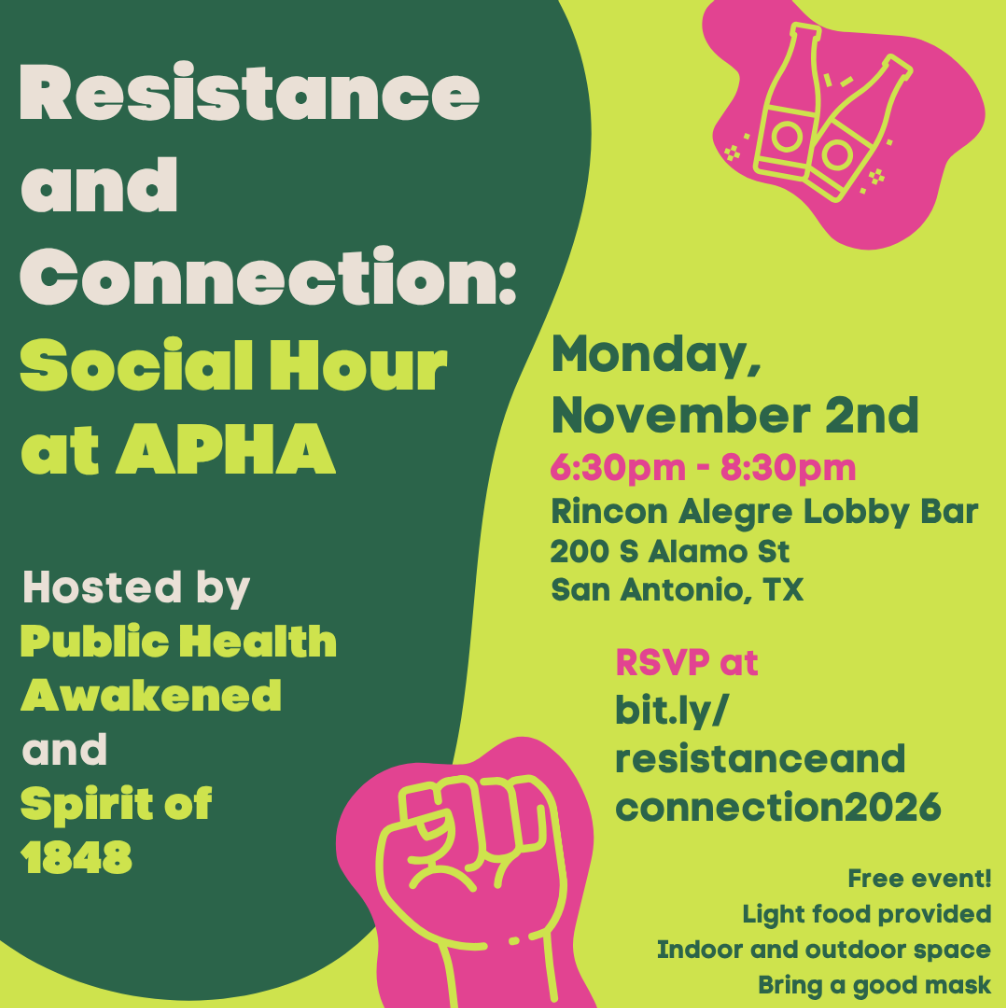
Click here to view the 1-page flyer for the joint social hour co-sponsored by the Spirit of 1848 + Public Health Awakened
Released: August 17, 2026 (updated: September 2, 2026)
In year two now of the relentless attacks on health justice & social justice by the current US federal administration, both in & outside of the US, the Spirit of 1848 is grateful to share our final program AND our 1-page flyer for the American Public Health Association’s 154th Annual Meeting and Expo, November 1-4, 2026, to be held in San Antonio, TX. This meeting takes place when the mid-term elections will be underway, at a time of progressive organizing for social justice & health justice on so many fronts: in the streets, in the courts, in our workplaces, and in electoral politics. Such times require solidarity – and for this reason, our Spirit of 1848 theme for 2026 is:
“In solidarity we thrive — health justice across ‘borders’ and generations!”
The links to the sessions are as follows:
Link to 1848 sessions: https://apha.confex.com/apha/2026/meetingapp.cgi/Program/2708
Link to overall APHA program: https://apha.confex.com/apha/2026/meetingapp.cgi/Home/0
The official theme for the American Public Health Association (APHA) annual meeting in 2026 is: “Together We Thrive: Health Across the Lifespan” – and for all to thrive together, we must call for and practice solidarity, not only across the many public health issues at stake, but across all sectors of society. Hence our theme.
We list below the roster of our sessions — along with our two special events! — and we look forward to joining together in San Antonio, Texas, to bolster our spirits as we move forward the work for health justice.
| Note: APHA recognizes the concerns that members have expressed re the conference being held in Texas, especially in relation to politicians—and the corporations & right-wing organizations that lobby them—who produce policies that harm so many people via attacks on immigrant rights, reproductive justice, LGBQ + transgender health care and rights, academic freedom, environmental & climate justice, union organizing, electoral justice & gerrymandering, and more – the list goes on & on (for examples of the sorts of reactionary policies these right-wing coalitions proudly claim & are additionally seeking to enact, see, for example: https://www.texaspolicy.com/ …) The APHA statement about the location (booked a decade ago & prohibitively costly to cancel) is as follows: Why San Antonio? A Message About Our 2026 Annual Meeting and Expo Location We understand that holding the APHA Annual Meeting and Expo in Texas this year raises concerns for many in our community, given the state’s current political climate and recent policy decisions that conflict with our organization’s values and mission. San Antonio is a diverse, vibrant, and proudly progressive city with a long history of activism, advocacy and community-based public health work. By showing up, we have the opportunity to support local communities doing critical work and make our voices heard in Texas, a state that could benefit greatly from a public health approach. And in full transparency, our contract with the city of San Antonio was signed almost a decade ago, long before the political landscape evolved into what it is today. Canceling or relocating APHA 2026 would have significant financial and logistical consequences—not just for APHA, but for our members, exhibitors and partners who look forward to and rely upon this gathering. Our presence matters. Being in San Antonio allows us to: – Support local advocates and organizations aligned with our mission – Elevate voices in a state that hasn’t hosted the APHA Annual Meeting in decades – Welcome public health professionals to a new city – Demonstrate that our values don’t stop at state lines We are committed to creating a safe, inclusive and empowering experience for all who attend—and to ensuring our time in San Antonio reflects not just where we are, but who we are. We hope you will join us in building a powerful, values-driven presence in 2026. |
| Spirit of 1848 sessions (APHA 2026) – by day, time slot, Spirit of 1848 focus, and topic (APHA conference time) AND our co-sponsored session & co-sponsored social hour | |||
| Monday, Nov 2, 2026 | 8:30 am to 10:00 am | Activist | In solidarity we act: organizing for health justice across “borders” and generations |
| 10:30 am to 12 noon | History | In solidarity we remember: Histories of struggles for health justice across ‘borders’ and generations | |
| 2:30 to 4:00 pm | Politics of public health data | In solidarity we thrive: evidence, fixing missing evidence, & accountability for health justice | |
| 6:30 to 8:30 pm | Joint social hour with Public Health Awakened | “Resistance and Refreshment Social Hour” – Spirit of 1848 and Public Health Awakened | |
| Tuesday, Nov 3, 2026 | 10:30 am to 12 noon | Integrative | Solidarity Forever: Health Justice, Thriving, & Everything Everywhere All at Once, continued! |
| 12:30 pm to 1:30 pm | Student poster | Spirit of 1848 social justice & public health student poster session | |
| 2:30 pm to 4:00 pm | Progressive pedagogy | Teaching for Solidarity Across “Borders” and Generations for Health Justice | |
| 6:30 pm to 8:00 pm | Labor/business meeting | Annual meeting to discuss & plan Spirit of 1848 program & activities | |
See very end of document for a reminder of: “Why 1848?” – our recently updated timeline!
Below we provide 3 versions of our final program (with ALL TIMES IN APHA CONFERENCE TIME):
1) the session titles only
2) the session titles and titles of the presentations included in each session
3) the session titles, titles of presentations, and their abstracts
For the on-line program, see:
Link to 1848 sessions: https://apha.confex.com/apha/2026/meetingapp.cgi/Program/2708
Link to overall APHA program: https://apha.confex.com/apha/2026/meetingapp.cgi/Home/0
You can download this final program here, along with a 1‑page flyer (two-sided) here.
We look forward to seeing everyone in San Antonio, TX this fall! – and to uplifting our spirits & amplifying our defiance against illiberal oligarchic authoritarian fundamentalist rule by being together in the Spirit of 1848 – a spirit that inspires us in all we do in our work and fight for health justice!
—– SPIRIT OF 1848 PROGRAM: 3 VERSIONS —–
1) SESSION TITLES ONLY
Link to 1848 sessions: https://apha.confex.com/apha/2026/meetingapp.cgi/Program/2708
SPIRIT OF 1848 SESSIONS
-> Monday, November 2, 2026
| Mon, Nov 2, 2026 | 8:30 am to 10:00 am |
| Activist session | In solidarity we act: organizing for health justice across “borders” and generations |
| Session 3063.0 | HBGCC: ROOM 303B |
| Mon, Nov 2, 2026 | 10:30 am to 12 noon |
| Social history of public health | In solidarity we remember: Histories of struggles for health justice across ‘borders’ and generations |
| Session 3127.0 | HBGCC: ROOM 303B |
| Mon, Nov 2, 2026 | 2:30 pm to 4:00 pm |
| Politics of public health data | In solidarity we thrive: evidence, fixing missing evidence, & accountability for health justice |
| Session 3196.0 | HBGCC: ROOM 303B |
| Mon, Nov 2, 2026 | 6:30 pm to 8:30 pm |
| “Resistance and Refreshment” Social Hour – Spirit of 1848 + Public Health Awakened — Location: Rincon Alegre Lobby Bar (inside the Hilton Palacio del Rio), 200 S Alamo St, San Antonio, TX (1 block from the convention center!) — RSVP here (free! – light food provided, and you can purchase drinks & dinner) | |
-> Tuesday, November 3, 2026
| Tues, Nov 3, 2026 | 10:30 am to 12 noon |
| Integrative session | Solidarity Forever: Health Justice, Thriving, & Everything Everywhere All at Once, continued! |
| Session 4125.0 | HBGCC: ROOM 303B |
| Tues, Nov 3, 2026 | 12:30 pm to 1:30 pm |
| Student poster session | Spirit of 1848 social justice & public health student poster session |
| Row 29 | HBGCC: ROOM Exhibit Hall 3-4 |
| Tues, Nov 3, 2026 | 2:30 pm to 4:00 pm |
| Progressive pedagogy | Teaching for Solidarity Across “Borders” and Generations for Health Justice |
| Session 4187.0 | HBGCC: ROOM 303B |
| Tues, Nov 3, 2026 | 6:30 pm to 8:00 pm |
| Labor/business meeting | Annual meeting to discuss & plan Spirit of 1848 program & activities |
| Session (n/a) | Grand Hyatt: ROOM Mission B |
2) SESSION TITLES & PRESENTATION TITLES (speaker names: in bold)
Link to 1848 sessions: https://apha.confex.com/apha/2026/meetingapp.cgi/Program/2708
SPIRIT OF 1848 SESSIONS
-> Monday, November 2, 2026
| Mon, Nov 2, 2026 | 8:30 am to 10:00 am | |
| Activist session | In solidarity we act: organizing for health justice across “borders” and generations | |
| Session 3063.0 | HBGCC: ROOM 303B | |
| 8:30 am | Introduction: “In solidarity we act: organizing for health justice across ‘borders’ and generations” Catherine Cubbin, PhD1, Nylca J. Munoz Sosa, JD, LLM, DrPH2 and Rebekka Lee, ScD3 (1) Austin, TX, (2) Pontifical Catholic University of Puerto Rico, Ponce, PR, (3) Harvard T.H. Chan School of Public Health, Boston, MA | |
| 8:35 am | Healing Hands Community Birthing Project: Community Based Birth and Reproductive Justice Darline Turner, PA, MHS Healing Hands Community Doula Project, Austin, TX | |
| 8:50 am | Community systems of care: resisting top-down control in relationships, communities, and society Jordan Pacelli Everett, LMSW Prevention Institute, Houston, TX | |
| 9:05 am | Community organizing strategies for health justice: successes, challenges, and vision for the future Lara Jirmanus, MD, MPH Cambridge Health Alliance, Cambridge, MA | |
| 9:20 am | In Solidarity We Thrive: A Participatory Action Research Study on Building Organizational Readiness for Anti-Racist Public Health Practice Michele Bildner, DrPH, MPH, MCHES Utah Valley University, Orem, UT | |
| 9:35 am | Q&A | |
| Mon, Nov 2, 2026 | 10:30 am to 12 noon | |
| Social history of public health | In solidarity we remember: Histories of struggles for health justice across ‘borders’ and generations | |
| Session 3127.0 | HBGCC: ROOM 303B | |
| 10:30 am | Introduction: “In solidarity we remember: histories of struggles for health justice across ‘borders’ and generations” Marian Moser Jones, PhD, MPH1, Charlene Kuo2, Anne-Emanuelle Birn3, Maria John4 and Luis Aviles, PhD5 (1) Columbus, OH, (2) Stanford Mussallem Center for Biodesign, Germantown, MD, (3) Toronto, Canada, (4) University of Massachusetts Boston, Boston, MA, (5) Kilometro Cero, Boqueron, PR | |
| 10:35 am | The revitalization of the Karankawas of the Texas Gulf Coast and their health practices Tim Seiter, PhD University of Texas, Tyler, Tyler, TX | |
| 11:00 am | The revitalization of the Karankawa Peoples of Texas: A personal experience Chiara Lillie Beaumont The Karankawa Tribe, Hawk Clan, Austin, TX | |
| 11:25 am | Native American health and settler-colonialism: the history of a relationship Maria K. John, PhD University of Massachusetts Boston, Boston, MA | |
| 11:35 am | Beyond history’s silence: learning from Karankawa revitalization and healthways Marian Moser Jones, PhD, MPH The Ohio State University, Columbus, OH | |
| 11:45 am | Q&A | |
| Mon, Nov 2, 2026 | 2:30 pm to 4:00 pm | |
| Politics of public health data | In solidarity we thrive: evidence, fixing missing evidence, & accountability for health justice | |
| Session 3196.0 | HBGCC: ROOM 303B | |
| 2:30 pm | Introduction: “In solidarity we thrive: evidence, fixing missing evidence, & accountability for health justice” Zinzi D Bailey, ScD, MSPH1, Craig Dearfield, PhD2, Catherine Cubbin, PhD3 and Nancy Krieger, PhD4 (1) University of Minnesota, South Miami, FL, (2) Virginia Commonwealth University, Richmond, VA, (3) Austin, TX, (4) Harvard TH Chan School of Public Health, Boston, MA | |
| 2:35 pm | Disclaimers as disinformation: federal subversion of court-ordered restorations of federally censored public health, environmental, and climate change websites Nancy Krieger, PhD1, Ashlynn Wimer2, Meg Matthews, MPH3, Nykesha Johnson, MPH2 and Jarvis Chen, ScD4 (1) Harvard TH Chan School of Public Health, Boston, MA, (2) Harvard TH Chan School of Public Health, Boston, MA, (3) Harvard TH Chan School of Public Health, Boston, MA, (4) Harvard T.H. Chan School of Public Health, Boston, MA | |
| 2:50 pm | Data Behind Bars: A surveillance system evaluation of the UCLA COVID-19 data monitoring and reporting system in U.S. jails Erinn Bacchus, PhD, MPH Lehigh University, Bethlehem, PA | |
| 3:05 pm | The politics of population data: Heterogeneity, surveillance, and justice-oriented epidemiology for MENA communities Nadia Abuelezam, ScD Michigan State University College of Human Medicine, East Lansing, MI | |
| 3:20 pm | Epistemic Integration and the Settler Colonial Determination of Health Bram P Wispelwey, MD1, Lana Ray, PhD2, Dina Hamideh, PhD, MS3, Steven De La Torre, PhD4, Nadine Bahour5, Artair Rogers6, David Mills, MD7 and Eric Hekler, PhD8 (1) Brigham and Women’s Hospital – Boston, MA, Boston, MA, (2) Anishinaabe Kendaasiwin Institute, Lakehead University, Thunder Bay, ON, Canada, (3) San Diego State University, San Diego, CA, (4) School of Information, University of Michigan, Ann Arbor, MI, (5) Harvard University, Boston, MA, (6) Harvard University, Population Health Sciences and Harvard FXB Health and Human Rights Center, Roxbury, MA, (7) FXB Center for Health and Human Rights, Harvard University, Boston, MA, (8) University of California, San Diego, La Jolla, CA | |
| 3:35 pm | Q&A | |
| Mon, Nov 2, 2026 | 6:30 pm to 8:30 pm |
| “Resistance and Refreshment” Social Hour – Spirit of 1848 + Public Health Awakened — Location: Rincon Alegre Lobby Bar (inside the Hilton Palacio del Rio), 200 S Alamo St, San Antonio, TX (1 block from the convention center!) — RSVP here (free! – light food provided, and you can purchase drinks & dinner) | |
->Tuesday, November 3, 2026
| Tues, Nov 3, 2026 | 10:30 am to 12 noon | |
| Integrative session | Solidarity Forever: Health Justice, Thriving, & Everything Everywhere All at Once, continued! | |
| Session 4124.0 | HBGCC: ROOM 303B | |
| 10:30 am | Introduction: “Solidarity Forever: health justice, thriving, & everything everywhere all at once, continued!” Nancy Krieger, PhD Harvard TH Chan School of Public Health, Boston, MA | |
| 10:35 am | Protecting and building healthful Indigenous futures: everything everywhere all at once Karina Walters, MSW, PhD National Institutes of Health, Washington, DC | |
| 10:55 am | Attacks on Higher Education, Resistance, and Building Communities of Care Karma Chávez University of Texas at Austin, Austin, TX | |
| 11:15 am | The People’s Health Movement and the Championing of Health Justice: Shared Solidarity Across Borders Jennifer Ware, MPH1 and Anne-Emanuelle Birn2 (1) The Ubuntu Center, Philadelphia, PA, (2) Toronto, Canada | |
| 11:35 am | Discussant: “Solidarity Forever: Health Justice, Thriving, & Everything Everywhere All at Once, continued!” Mary Bassett, MD, MPH Harvard TH Chan School of Public Health, Boston, MA | |
| 11:45 am | Q & A | |
| Tues, Nov 3, 2026 | 12:30 pm to 1:30 pm | |
| Student poster session | Spirit of 1848 social justice & public health student poster session | |
| Row 29 | HBGCC: ROOM Exhibit Hall 3-4 | |
| #1 | The importance of extra-institutional collaboration and support among early career researchers Seth Eaton, MPH1 and Sebastian Otero2 (1) New York University School of Global Public Health, New York, NY, (2) Chicago, IL | |
| #2 | Jubilee Park: A community-based initiative with integrated healthcare to address social and health inequities in underserved communities Victoria Raines, MPH University of Texas at Southwestern, Dallas, TX | |
| #3 | Occupational hazards of carcerality: A national examination of premature death among US corrections officers and other public safety workers during the first two years of the COVID-19 pandemic, 2020–2021 Jasmine Graves, PhDc1, Jarvis Chen, ScD2, Mary Bassett, MD, MPH3, Sandra Smith, PhD4, Monik Botero, ScD1 and Nancy Krieger, PhD5 (1) Harvard T.H. Chan School of Public Health, Cambridge, MA, (2) Harvard T.H. Chan School of Public Health, Boston, MA, (3) Harvard TH Chan School of Public Health, Boston, MA, (4) Harvard Kennedy School, Cambridge, MA, (5) Harvard TH Chan School of Public Health, Boston, MA | |
| #4 | Anti-Trans Politics, Resistance, and Health Among Transgender and Gender-Diverse Individuals in Florida Luis Gonzalez-Diaz Gainesville, FL | |
| #5 | Impact of park access on mental and physical health in rural Texas: Insights from the Texas Healthy Parks Plan Miyu Kato1, Lindsay Sansom, PhD2, Stephen Labuda3, Kyra Williams4 and Marian Olayon4 (1) Texas A&M University, School of Public Health, College Station, TX, (2) Wimberley, TX, (3) College Station, TX, (4) Texas A&M University, College Station, TX | |
| #6 | If I Must Die: Public Health, Power, and Palestine Cielo Munoz, MPH1, Stacy Castellanos2, Samira Khabbazzadeh-Rashti, MPH1, Roxana Rezai, PhD3, Wilson Hammett, PhD MPH4, Amelia Reese Masterson, MPH2, Sarah Beth Stein, MPH2, Erin Manalo-Pedro, MPH4 and Randall Kuhn, PhD5 (1) Los Angeles, CA, (2) UCLA, Los Angeles, CA, (3) UCLA Fielding School of Public Health, Los Angeles, CA, (4) University of California, Los Angeles, Los Angeles, CA, (5) Fielding School of Public Health, Santa Monica, CA | |
| #7 | Mixed Methodology Research and Ethical Considerations on Climate Inclusive Health Policy Research in India Srabastee De Bhaumik Arlington, TX | |
| #8 | Deepening community engaged teaching in the course, Epidemics of Injustice: Community Resistance for Public Health Regeneration Caesar Thompson1, Jeni Hebert-Beirne, PhD2 and Nancy Valentin2 (1) University of Illinois Chicago, Chicago, IL, (2) Chicago, IL | |
| #9 | “Ancestral healing”: speculative decolonial ancestry as refugee organizing pedagogy in a right-wing community of color Emma Tran UCLA, Los Angeles, CA | |
| Tues, Nov 3, 2026 | 2:30 pm to 4:00 pm | |
| Progressive pedagogy | Teaching for Solidarity Across “Borders” and Generations for Health Justice | |
| Session 4187.0 | HBGCC: ROOM 303B | |
| 2:30 pm | Introduction: “Teaching for solidarity across ‘borders’ and generations for health justice” Nylca J. Munoz Sosa, JD, LLM, DrPH1, Rebekka Lee, ScD2, Lisa Moore3 and Vanessa Simonds4 (1) Pontifical Catholic University of Puerto Rico, Ponce, PR, (2) Harvard T.H. Chan School of Public Health, Boston, MA, (3) El Cerrito, CA, (4) Bozeman, MT | |
| 2:35 pm | Teaching Public Health in a Dying Empire: Case Studies in Critical Fugitive Pedagogies for Health Justice Ans Irfan, MD, EdD, DrPH, ScD, MPH, MRPL, MA The Public Health Praxis Center, Washington, DC | |
| 2:50 pm | Teaching environmental and labor justice and sustainability, through globally informed textile production skills Aleks Babic, Ph.D., M.P.H. Guilford College, Greensboro, NC | |
| 3:05 pm | Leadership development as health justice pedagogy: Insights from a capacity building program for community health leaders Meriam Mikre, MPH HSPH, 677 Huntington Ave, Boston MA 02115, Boston, MA | |
| 3:20 pm | Teaching public health today: Pedagogical strategies to build solidarity Sarah Vos, Ph.D. University of Kentucky, Lexington, KY | |
| 3:35 pm | Q&A | |
| Tues, Nov 3, 2026 | 6:30 pm to 8:00 pm |
| Labor/business meeting | Annual meeting to discuss & plan Spirit of 1848 program & activities |
| Session (n/a) | Grand Hyatt: ROOM Mission B |
3) SESSION TITLES & PRESENTATION TITLES & ABSTRACTS (speaker names: in bold)
Link to 1848 sessions: https://apha.confex.com/apha/2026/meetingapp.cgi/Program/2708
SPIRIT OF 1848 SESSIONS
-> Monday, November 2, 2026
| Mon, Nov 2, 2026 | 8:30 am to 10:00 am | |
| Activist session | In solidarity we act: organizing for health justice across “borders” and generations | |
| Session 3063.0 | HBGCC (Henry B. González Convention Center): ROOM 303B | |
| 8:30 am | Introduction: In solidarity we act: organizing for health justice across ‘borders’ and generations Catherine Cubbin, PhD1, Nylca J. Munoz Sosa, JD, LLM, DrPH2 and Rebekka Lee, ScD3 (1) Austin, TX, (2) Pontifical Catholic University of Puerto Rico, Ponce, PR, (3) Harvard T.H. Chan School of Public Health, Boston, MA Abstract: This session will focus on Texas-based activist work on health-related justice issues relating to the current political landscape. The introduction will frame the issues presented in relation to the fundamental need for solidarity to inform work for health justice. Presentations could include, but are not limited to, immigrant protection, access to healthcare, policing/incarceration, reproductive health, social and economic justice, LGBTQ health justice, political participation, and/or environmental justice. | |
| 8:35 am | Healing Hands Community Birthing Project: Community Based Birth and Reproductive Justice Darline Turner, PA, MHS Healing Hands Community Doula Project, Austin, TX Abstract: “Healing Hands Community Birthing Project (HHCBP) is a birth support and workforce development nonprofit organization established in Central Texas in 2019, with expansion to Greater Houston Texas in 2023. Committed to Birth and Reproductive Justice, we have developed a comprehensive birth support program that provides no cost direct non-medical pregnancy, labor and delivery, and postpartum support to BIPOC childbearing families beginning at approximately 16 weeks gestation and lasting up until 18 months postpartum. We also provide extensive case management and social service support via referrals and community resource access. Our birth-workers, Perinatal Community Health workers (PCHWs), are certified as community-based doulas and trained as community health workers via our proprietary PCHW curriculum. Our mission is to produce a maternity workforce that provides wrap around physical, social and emotional support services, eliminates negative birth outcome disparities in BIPOC childbearing people, improves birth outcomes, reduces maternal morbidity and mortality and pays birth workers a living, abundant wage. Our vision is for all childbearing Texans to have all of the support and resources they need, ease acquiring these resources, the ability to raise the children they desire to have, and for those providing them services and support to be paid living wages with benefits and employment support. We will present reflections on founding and growing the organization, with a focus on challenges we’ve faced and the successes we’ve accomplished.” | |
| 8:50 am | Community systems of care: resisting top-down control in relationships, communities, and society Jordan Pacelli Everett, LMSW Prevention Institute, Houston, TX Abstract: Gender-based violence (GBV) inflicts harm in communities, disproportionately affecting people excluded from opportunity, young people, and pregnant people. GBV is pervasive across the Greater Houston/Harris County Region, exacerbated by structural racism and state and national contexts, including Texas’s near-total abortion ban and deliberate policies that undermine gender and racial equity. Current models to address GBV remain narrowly focused on individual behavior and punitive systems that further harm families and communities, erode trust, and stigmatize dialogue and action. Safety and Healing in Networks of Equity Houston (SHINE Houston) reimagines GBV prevention through a collective healing and relational health approach that centers community leadership and systems of solidarity, care, and repair, outside of punishment-based approaches. Grounded in health equity, racial justice, and Indigenous frameworks, SHINE Houston builds durable community ecosystems where relational health and collective well-being flourish across families, generations, and neighborhoods. SHINE Houston artists, maternal health advocates, housing leaders, and organizations serving men and boys of color collaboratively organize participatory art installations, cultural healing practices, and neighborhood-based hubs that cultivate trust, advance collective action, and influence culture, narratives, systems, and policies. The project uses a braided data approach to measure procedural, distributional, and structural equity, e.g., community ownership, equitable resource distribution, and policy alignment in sectors such as housing and maternal health. Amidst rising authoritarianism and democratic backsliding, SHINE Houston’s approach to relational health and GBV prevention offers a powerful model of community systems of care and repair and resistance to top-down control in relationships, communities, and society. | |
| 9:05 am | Community organizing strategies for health justice: successes, challenges, and vision for the future Lara Jirmanus, MD, MPH Cambridge Health Alliance, Cambridge, MA Abstract: Social medicine praxis, which emphasizes the integration of theory and political action to address health inequities, has emerged as a critical framework for public health practice. Rooted in Latin American social medicine traditions that combine historical materialism with community engagement, this approach views health and illness as dialectic processes shaped by social, economic, and political structures rather than merely biological phenomenal. Community organizing serves as a practical mechanism for enacting social medicine praxis by mobilizing collective action to address structural determinants of health and shift power relations toward marginalized populations. Through a discussion of case examples of organizing in with healthcare workers in solidarity with immigrant communities, and then with healthcare workers and disability justice advocates to defend public health and health equity, we will present a conceptual framework of social medicine for health justice, 1) Unpack the structural and political context 2) Narrative intervention 3) Connect and build upon existing networks 4) Build constituency to shift power toward the marginalized 5) Reflection. Lastly, we will reflect on the successes and challenges of community organizing for health justice. | |
| 9:20 am | In Solidarity We Thrive: A Participatory Action Research Study on Building Organizational Readiness for Anti-Racist Public Health Practice Michele Bildner, DrPH, MPH, MCHES Utah Valley University, Orem, UT Abstract: Background & Study Objective(s): While public health organizations increasingly declare racism a public health crisis, a “science-to-practice” gap persists. This research aims to shift performative declarations toward institutional accountability by identifying the readiness required for professional associations to implement anti-racist innovations. It addresses how “all-volunteer” structures—the profession’s grassroots—move from passive adoption to active implementation of health justice mandates. Relevance to HSKS: This study shifts the health science knowledge system by centering “Knowledge-In-Action” and practitioner expertise. It represents a vertical advancement in health equity research by applying a decolonized, participatory framework that prioritizes structural change over incremental reform. Methodology: Utilizing Participatory Action Research (AR) across six “Look-Think-Act” cycles, the study was grounded in the Interactive Systems Framework. It integrated the R=MC² readiness heuristic (Readiness = Motivation x General Capacity x Innovation-Specific Capacity) to build organizational power through collective sensemaking. Methods and Tools: Conducted in 2023–2024 with SOPHE Chapter leaders, the study employed mixed methods, including quantitative readiness surveys and qualitative dyadic interviews. Data were analyzed using the SOAR™ framework to identify strategic levers for equity-focused change. Results: Findings revealed that while Motivation was high due to national alignment, Innovation-Specific Capacity—particularly advocacy skills and resource allocation—remained a significant barrier to implementation. Conclusions: Organizational readiness for anti-racism is a dynamic capacity fostered through targeted support systems and institutional accountability. Policy and/or Practice Implications: Associations must shift from top-down mandates toward robust “Support Systems” that build local capacity through explicit anti-racist toolkits and shared accountability structures. | |
| 9:35 am | Q&A | |
| Mon, Nov 2, 2026 | 10:30 am to 12 noon | |
| Social history of public health | In solidarity we remember: Histories of struggles for health justice across ‘borders’ and generations | |
| Session 3127.0 | HBGCC: ROOM 303B | |
| 10:30 am | Introduction: In solidarity we remember: histories of struggles for health justice across ‘borders’ and generations Marian Moser Jones, PhD, MPH1, Charlene Kuo2, Anne-Emanuelle Birn3, Maria John4 and Luis Aviles, PhD5 (1) Columbus, OH, (2) Stanford Mussallem Center for Biodesign, Germantown, MD, (3) Toronto, Canada, (4) University of Massachusetts Boston, Boston, MA, (5) Kilometro Cero, Boqueron, PR Abstract: This session explores a range of past health justice efforts in such areas as environmental organizing, transnational solidarity, and health-related movements for Indigenous and racial justice, with the aim of bringing current struggles into both sobering and motivating historical perspective. The introduction will frame the presentations in relation to the importance of solidarity for public health work for health justice. Invited presentations may address one or more of the following topics: — US/Mexico “borderlands” & health justice — Intergenerational fights re: Big Oil, Cancer Alley, AI (water & land use, etc.) & health justice — Resurfacing Indigenous histories of Texas/Mexico & health justice — Transnational struggles for climate, biodiversity, and health justice — Health justice in sociocultural and intellectual “borderlands” (engaging with Gloria Anzaldúa’s concept of a borderland as a vibrant intersectional space of identities, classes, and cultures). Note: all abstracts for this session will be SOLICITED (due: March 31, 2026). Per Spirit of 1848 policy, we will include presentations that bring a critical Indigenous lens, drawing on Indigenous theories, knowledge, and methods. | |
| 10:35 am | The revitalization of the Karankawas of the Texas Gulf Coast and their health practices Tim Seiter, PhD University of Texas, Tyler, Tyler, TX Abstract: This presentation examines the recent revitalization of Karankawa culture and the health practices of these Texas Gulf Coast peoples. For centuries, colonizers spread propaganda portraying the Karankawa as an unhealthy and unhygienic people. The historical record tells a much different story. Far from being sickly, the Karankawa bathed daily in rivers with near-ritualistic dedication, even breaking through layers of ice to do so. These first peoples also possessed knowledge of dozens of medicinal herbs capable of treating a wide array of ailments, and they maintained such a nutritious diet that they became one of the tallest Indigenous groups in the region. A French child abducted and later adopted by the Karankawa in the seventeenth century bore witness to this reality. In his own words, these coastal Natives “lived to an advanced age and are nearly always in an excellent state of health.” Why, then, did colonizers insist otherwise? This talk offers an answer: it was a strategy of othering—a means of dehumanizing a people whose land colonizers sought to control. | |
| 11:00 am | The revitalization of the Karankawa Peoples of Texas: A personal experience Chiara Lillie Beaumont The Karankawa Tribe, Hawk Clan, Austin, TX Abstract: This presentation starts with a traditional introduction that honors the contemporary and ancestral homelands, the lineage, clan, and preferred name. The main topics of the presentation include early life as a Karankawa child struggling to find the rest of her people, the struggles of being indigenous but not federally recognized in modern society, the revitalization of the people, the tribe’s views on health, and the calls to action that have been organized to fight. The presentation concludes with the ties federally unrecognized tribal communities maintain with the land and scholars and environmental activists, and how it is possible to decolonize scholarly and environmentally conscious spaces to ensure balance is maintained between us all. | |
| 11:25 am | Native American health and settler-colonialism: the history of a relationship Maria K. John, PhD University of Massachusetts Boston, Boston, MA Abstract: Indigenous health scholar Margo Greenwood has written that, “colonialism has yet to be fully and consistently accounted for as a significant determinant of health.” How can we, as scholars of public health and history, work to better elucidate and illuminate the relationship between health and colonialism? What role have the structures and politics of federal recognition played in determinants of Native American health? In bringing together the presentations of Dr. Tim Seiter and Chiara Beaumont, the discussant on this panel seeks to put the example of the recent revitalization of Karankawa culture and the health practices of these Texas Gulf Coast peoples, into conversation with broader histories of Native American health and the impacts of settler colonialism, particularly as it pertains to questions of federal recognition and non-recognition. | |
| 11:35 am | Beyond history’s silence: learning from Karankawa revitalization and healthways Marian Moser Jones, PhD, MPH The Ohio State University, Columbus, OH Abstract: This discussion explores, with panelists and the audience, what it means to questions of identity, health, and justice for people(s) to emerge from the silence of the archive (while existing all along). The discussant will probe why it matters broadly to listen and co-create new narratives of indigenous inclusion and revitalization, and how these efforts can be supported and furthered in the future. | |
| 11:45 am | Q&A | |
| Mon, Nov 2, 2026 | 2:30 pm to 4:00 pm | |
| Politics of public health data | In solidarity we thrive: evidence, fixing missing evidence, & accountability for health justice | |
| Session 3196.0 | HBGCC: ROOM 303B | |
| 2:30 pm | Introduction: In solidarity we thrive: evidence, fixing missing evidence, & accountability for health justice Zinzi D Bailey, ScD, MSPH1, Craig Dearfield, PhD2, Catherine Cubbin, PhD3 and Nancy Krieger, PhD4 (1) University of Minnesota, South Miami, FL, (2) Virginia Commonwealth University, Richmond, VA, (3) Austin, TX, (4) Harvard TH Chan School of Public Health, Boston, MA Abstract: This session will focus on our current data landscape, namely evidence, fixing missing evidence, and accountability for health justice. The introduction will frame the presentations in relation to principles of solidarity. Presentations could include, but are not limited to: – Data preservation for health equity and challenging authoritarian erasure – Reimagining and building new data infrastructure, technologies, & policies for health justice – Research using all the banned words: still fighting for health justice and evidence for accountability – Weaponizing the US census and other data sources vital for health justice research & monitoring – Who is being classified how, by whom, and why – and how does that affect data for health justice? | |
| 2:35 pm | Disclaimers as disinformation: federal subversion of court-ordered restorations of federally censored public health, environmental, and climate change websites Nancy Krieger, PhD1, Ashlynn Wimer2, Meg Matthews, MPH3, Nykesha Johnson, MPH2 and Jarvis Chen, ScD4 (1) Harvard TH Chan School of Public Health, Boston, MA, (2) Harvard TH Chan School of Public Health, Boston, MA, (3) Harvard TH Chan School of Public Health, Boston, MA, (4) Harvard T.H. Chan School of Public Health, Boston, MA Abstract: Public health problem: Since January 2025, the federal administration has removed federal public health websites deemed inconsistent with their new Executive Orders and affixed disclaimers to those restored by court orders. Objectives: To document the types of disclaimers being used on federal public health websites. Methods: Between February 2, 2026 and March 12, 2026, we conducted a systematic search of disclaimers used on: (1) websites restored by a Doctors for America lawsuit, and (2) current CDC “banner” websites. Results: Among the 364 websites identified, we found six unique disclaimers: 3 invoke “gender ideology,” 1 states the website is “being modified to comply with President Trump’s Executive Orders”, and 2 are very rarely used (1 used once regarding childhood vaccination; 1 used twice referring to an Executive Order about “reduction in federal bureaucracy”). Overall, 62% of the websites featured gender ideology disclaimers: 18 of the 21 focused on gender identity and 207 of the 343 without substantive discussion of gender identity. Among these latter 343 websites, gender ideology disclaimers nevertheless appeared on: 145 of 179 with some mention of “gender” or “sex”; all 18 focused on LGB sexuality; 61 of 77 focused on HIV; 49 of 55 focused on reproductive health; all 8 focused on environmental justice; and the 1 website focused on climate change. Conclusion: Spurious disclaimers serve as disinformation that can exacerbate public distrust of vetted public health knowledge. Court-ordered restorations of federally censored public health websites is being subverted by use of disclaimers that constitute disinformation. | |
| 2:50 pm | Data Behind Bars: A surveillance system evaluation of the UCLA COVID-19 data monitoring and reporting system in U.S. jails Erinn Bacchus, PhD, MPH Lehigh University, Bethlehem, PA Abstract: Background: The COVID-19 pandemic highlighted the need for transparent data in U.S. jails where high turnover and fragmented management prevented effective health monitoring. Without accurate and sufficient data, independent initiatives like the UCLA COVID Behind Bars Data Project became essential for public health reporting. Objectives: This study evaluates the UCLA COVID Behind Bars data monitoring and reporting system to identify its operational successes and determine if it may be adapted in the development of a standardized health surveillance system for jails. Methods: Using the CDC Framework for Public Health Surveillance Evaluation this study analyzes the system’s performance across pertinent attributes including data quality, stability, and representativeness, focusing on the issue between independent data collection and facility reporting. Results: While the evaluation reveals that the UCLA project provided essential building blocks for an effective system, it is constrained by systemic barriers. The primary limitation is its reliance on inconsistent, voluntary data collection and reporting by jail facilities, which undermines data stability and representativeness. However, the system demonstrated high flexibility in adapting to shifting reporting standards and provided access to extensive health data previously unavailable to public health officials. Conclusion: UCLA’s system offers a viable blueprint for carceral health monitoring, though it cannot compensate for the lack of mandatory reporting. Findings suggest that a standardized surveillance system, modeled after the UCLA system but supported by mandatory reporting requirements, is necessary to ensure that carceral health data is treated as an essential standard for public health and human rights. | |
| 3:05 pm | The politics of population data: Heterogeneity, surveillance, and justice-oriented epidemiology for MENA communities Nadia Abuelezam, ScD Michigan State University College of Human Medicine, East Lansing, MI Abstract: The classification of Middle Eastern and North African (MENA) populations within U.S. epidemiologic data systems reflects a fundamental challenge in measuring health inequities: how categories structure what can be known, counted, and acted upon. Persistent gaps in the identification of MENA populations across surveillance systems have limited the availability of reliable epidemiologic evidence on disease burden, risk factors, and access to care. Recent efforts to introduce a distinct MENA category in federal data standards represent an important shift; however, key methodological and equity considerations remain regarding how such a category is defined, implemented, interpreted, and adopted among community members. This presentation examines how MENA classification is operationalized across major epidemiologic data sources, including the U.S. Census, national health surveys, and administrative health data. It highlights challenges related to misclassification and substantial heterogeneity within MENA populations, complicating the generalizability of collected data. Utilizing community feedback and applied epidemiologic examples, the presentation illustrates how current data practices can obscure meaningful variation in health outcomes and limit the utility of analyses for decision-making. Centering community-driven data equity, this work emphasizes the importance of involving MENA communities in the design, governance, and interpretation of data and data systems. It argues for epidemiologic approaches that prioritize culturally grounded measures, improved sampling strategies, accountability to community-identified health priorities, and recognition of historical experiences of surveillance and monitoring. Advancing MENA health equity requires expanded data inclusion and a reorientation of epidemiologic practice toward participatory, context-responsive, and justice-oriented evidence production. | |
| 3:20 pm | Epistemic Integration and the Settler Colonial Determination of Health Bram P Wispelwey, MD1, Lana Ray, PhD2, Dina Hamideh, PhD, MS3, Steven De La Torre, PhD4, Nadine Bahour5, Artair Rogers6, David Mills, MD7 and Eric Hekler, PhD8 (1) Brigham and Women’s Hospital – Boston, MA, Boston, MA, (2) Anishinaabe Kendaasiwin Institute, Lakehead University, Thunder Bay, ON, Canada, (3) San Diego State University, San Diego, CA, (4) School of Information, University of Michigan, Ann Arbor, MI, (5) Harvard University, Boston, MA, (6) Harvard University, Population Health Sciences and Harvard FXB Health and Human Rights Center, Roxbury, MA, (7) FXB Center for Health and Human Rights, Harvard University, Boston, MA, (8) University of California, San Diego, La Jolla, CA Abstract: The mandate of health sciences — to understand and improve the health of all people — requires methods adequate to the full range of health-determining phenomena. Prevailing epidemiological frameworks grounded in linearity, discrete categorization, and decontextualized variables are valuable when phenomena operate through isolable, manipulable causal pathways, as when evaluating vaccine efficacy. However, a critically understudied hypothesized driver of Indigenous health inequities is settler colonialism: a dynamic, transtemporal process operating through ongoing land dispossession, systems of elimination, and relational restructuring. For such phenomena, these same frameworks are not merely insufficient and actively limit what can be seen, defined, and known about settler colonialism’s health determination. We critically examined the conditions under which settler colonialism can be meaningfully analyzed, underscoring how its key hypothesized structures are systematically overlooked when they do not adhere to dominant representational logics. Applying conventional methods to a phenomenon they cannot represent produces knowledge gaps and renders the settler colonialism hypothesis unrepresentable and thus unobservable, reinforcing epistemic exclusion. We introduce Indigenous epistemologies as foundational frameworks for knowledge production that foreground relationality, temporality, and interdependence when seeking to represent settler colonialism. Such perspectives, show how, prior to theory construction, dominant approaches influence what can be defined as essential concepts, what can be delimited as causal factors, and how variable relationships are understood. Recognizing these limitations, and seeking robust means of epistemological integration, is essential to ensuring the validity of health research and advancing methodological approaches that accurately account for the health impacts of settler colonialism among Indigenous populations. | |
| 3:35 pm | Q&A | |
| Mon, Nov 2, 2026 | 6:30 pm to 8:30 pm |
| “Resistance and Refreshment” Social Hour – Spirit of 1848 + Public Health Awakened — Location: Rincon Alegre Lobby Bar (inside the Hilton Palacio del Rio), 200 S Alamo St, San Antonio, TX (1 block from the convention center!) — RSVP here (free! – light food provided, and you can purchase drinks & dinner) | |
->Tuesday, November 3, 2026
| Tues, Nov 3, 2026 | 10:30 am to 12 noon | |
| Integrative session | Solidarity Forever: Health Justice, Thriving, & Everything Everywhere All at Once, continued! | |
| Session 4124.0 | HBGCC: ROOM 303B | |
| 10:30 am | Introduction: Solidarity Forever: health justice, thriving, & everything everywhere all at once, continued! Nancy Krieger, PhD Harvard TH Chan School of Public Health, Boston, MA Abstract: This session will build on our session last year, whose theme was “Making Health Justice: Everything, Everywhere, All at Once” — and extending it to make clear the links between solidarity and thriving. Invited presentations will engage with Spirit of 1848 foci regarding critical public health histories, data, activism, pedagogy, and the ongoing intergenerational work for health justice – including from critical Indigenous perspectives. The introduction will frame the session presentations in relation to principles of solidarity. | |
| 10:35 am | Protecting and building healthful Indigenous futures: everything everywhere all at once Karina Walters, MSW, PhD National Institutes of Health, Washington, DC Abstract: The work to protect and build healthful Indigenous futures in the US and globally is multifaceted and embraces the interconnections that underlie a perspective of “everything everywhere all at once.” I will speak to some of the efforts I have been involved in via the NIH Tribal Health Research Office and other avenues to reckon with the histories and legacies of Indian boarding schools and promoting Indigenous Peoples’ health. | |
| 10:55 am | Attacks on Higher Education, Resistance, and Building Communities of Care Karma Chávez University of Texas at Austin, Austin, TX Abstract: In this talk, I discuss the significance of centering practices of community care taking to support the physical and mental well being of faculty and staff whose teaching, research, and service are targeted by recent ideological takeovers. I emphasize specifically the impacts on organizers and activists who not only face threats to their livelihoods, but who fight publicly to defend their interests. | |
| 11:15 am | The People’s Health Movement and the Championing of Health Justice: Shared Solidarity Across Borders Jennifer Ware, MPH1 and Anne-Emanuelle Birn2 (1) The Ubuntu Center, Philadelphia, PA, (2) Toronto, Canada Abstract: The People’s Health Movement (PHM), founded in 2000 in Bangladesh, is an international network of health workers and activists who carry out research and advocacy, host conferences, and undertake joint political action. With a presence in 70 countries,. PHM hosts courses for activists around the world through its International People’s Health University, organizes WHO Watch and PAHO Watch, convenes a periodic People’s Health Assembly in Majority World settings, and coordinates the triannual publication Global Health Watch. PHM also played an instrumental role in the establishment of the WHO’s Commission on Social Determinants of Health (2005-2008). PHM is guided by the principle of political and social solidarity with allies across the world and works hand-in-hand with working class, gender justice, anti-militarism/imperialism, anti-extractivist, and other movements to redress the unequal distribution of political power and resources and help imagine more just and equitable societies. The United States and Canada make up the People’s Health Movement-North America region, currently comprising over 200 general subscribers and some 60 active decision-making members. PHM-North America involves individual activists working in concert with each other –and with allied social/political movements– towards common goals within each country and transnationally. The purpose of this presentation is to illustrate how activists across the two countries practice solidarity with other PHM country circles and global movements, past and present. We will share challenges faced and lessons learned in hopes that other researchers and activists may be inspired to become involved in global and transnational movements to ensure health for all. | |
| 11:35 am | Discussant: Solidarity Forever: Health Justice, Thriving, & Everything Everywhere All at Once, continued! Mary Bassett, MD, MPH Harvard TH Chan School of Public Health, Boston, MA Abstract: As discussant, I will reflect on the critical importance of principles of solidarity for work on health justice, within and across countries, informed by both the presentations on this panel and my many decades of work for health justice — in the US, in Zimbabwe (1985-2002), and as a public health leader, physician, researcher, and teacher, with recent positions including serving as the Commissioner of Health for the NYC Dept of Health and Mental Hygiene (2014-2018), Health Commissioner for NY State (2021-2022), and Director of the FXB Center for Health and Human Rights at Harvard University (2018-2025). | |
| 11:45 am | Q & A | |
| Tues, Nov 3, 2026 | 12:30 pm to 1:30 pm | |
| Student poster session | Spirit of 1848 social justice & public health student poster session | |
| Row 29 | HBGCC: ROOM Exhibit Hall 3-4 | |
| #1 | The importance of extra-institutional collaboration and support among early career researchers Seth Eaton, MPH1 and Sebastian Otero2 (1) New York University School of Global Public Health, New York, NY, (2) Chicago, IL Abstract: Rapidly shifting federal priorities have placed undue, extreme strain on early career researchers, particularly those committed to health and social justice. In this challenging context, it is worth reflecting on existing practices that serve as sources of resilience and strength. We present insights gained through the formation and initial year of an extra-institutional, values-based network of early career stigma researchers, the Stigma and Health Intervention Network for Equity (SHINE). SHINE currently comprises members from multiple early career stages (i.e., masters and doctoral students, individuals applying for masters and doctoral programs, postdoctoral fellows, and early-career faculty) from eleven different institutions. The focus on connection between those involved, de-emphasis on research productivity as a main goal of the network, and not needing institutional approval to exist has helped encourage a more collaborative and relatively less hierarchical environment. To date, SHINE has facilitated knowledge transfer between members, early career professional mentorship, emotional support while navigating uncertainty, and methodological feedback for proposed research projects. Although not initiated as a reaction to the current presidential administration and changes in federal priorities, SHINE has been a source of resilience and collective healing, helping improve the personal and professional well-being of members during a period in which fewer research resources are available. We believe SHINE has put into focus the multifaceted benefits of extra-institutional, relatively informal collaboration for early career researchers. We recommend that networks of researchers in other topic areas adopt similar models to maintain and strengthen personal and professional connection during the present political moment. | |
| #2 | Jubilee Park: A community-based initiative with integrated healthcare to address social and health inequities in underserved communities Victoria Raines, MPH University of Texas at Southwestern, Dallas, TX Abstract: Background Urban areas that have historically been disinvested experience persistent socioeconomic disadvantages, including high rates of poverty and crime, limited access to healthcare and food insecurity. In response to the persistent health and social inequities Southeast Dallas has faced since 1957, Jubilee Park opened in 1997 as a community-based initiative to address access to Education, Opportunity, Housing & Workforce, Safety and Health & Wellness with the addition of the Jubilee Health Clinic in 2022 operated by Parkland Health and mental health services through Jewish Family Services. Methods To understand and improve the impact of Jubilee Park, a mixed-methods study was implemented that included focus groups, self report surveys responses, and collection of chronic disease risk factors. Inclusion criteria for eligibility was 1) age 18 years or older, and 2) live in the specified Jubilee Park zone. Among 31 focus group participants, ages ranged from 32-74, 71% were Hispanic and 65% were female. Quantitative data collection is ongoing, currently with 113 participants. Findings Jubilee Park is a trusted community member, serving multigenerational families with the community showing gratitude for social justice through improved safety in partnership with the local police department, social connectedness, education and access to healthcare. Planned quantitative analysis comparing A1C, Proteinuria, Lipids, Blood Pressure and Body Mass Index from baseline, 6 and 12 month collection will evaluate potential health impacts associated with participation in Jubilee’s services. Implications Findings suggest that community-based programming with integrated healthcare may be critical in improving the social determinants of health for underserved communities. | |
| #3 | Occupational hazards of carcerality: A national examination of premature death among US corrections officers and other public safety workers during the first two years of the COVID-19 pandemic, 2020–2021 Jasmine Graves, PhDc1, Jarvis Chen, ScD2, Mary Bassett, MD, MPH3, Sandra Smith, PhD4, Monik Botero, ScD1 and Nancy Krieger, PhD5 (1) Harvard T.H. Chan School of Public Health, Cambridge, MA, (2) Harvard T.H. Chan School of Public Health, Boston, MA, (3) Harvard TH Chan School of Public Health, Boston, MA, (4) Harvard Kennedy School, Cambridge, MA, (5) Harvard TH Chan School of Public Health, Boston, MA Abstract: Objective: To investigate the occupational hazards of carcerality, we examined all-cause premature mortality (death before age 65) among U.S. correctional officers (COs) in 2020–2021, as compared to the general population and to police officers and EMTs/paramedics. Methods: We linked 2020–2021 National Vital Statistics System mortality records with American Community Survey population estimates, restricting to adults aged 15–64. We estimated age-adjusted rate ratios for premature mortality using Poisson multilevel models with state-level random intercepts and log-population offsets, adjusting for age, gender, race/ethnicity, and occupation. Results: In fully adjusted models, COs experienced the highest risk of premature mortality, with EMTs/paramedics in comparison having a 23% lower risk (RR = 0.77, 95% CI 0.73–0.82), and police officers having a 5% lower risk (RR = 0.95, 95% CI 0.92–0.99). Additionally, Black non-Hispanic (NH) COs had an 18% higher risk than White NH COs (RR = 1.18, 95% CI 1.07–1.29). Conclusion: In addition to harming people incarcerated, carceral systems may harm the health of people employed as COs. | |
| #4 | Anti-Trans Politics, Resistance, and Health Among Transgender and Gender-Diverse Individuals in Florida Luis Gonzalez-Diaz Gainesville, FL Abstract: Background: Since 2022, Florida has advanced a wave of anti-trans laws and policies targeting gender-affirming care, education, and public life. These measures have intensified political hostility toward transgender and gender-diverse (TGD) people and raised urgent concerns about health, safety, and wellbeing. While existing research has documented health inequities among TGD populations, less is known about how anti-trans governance is experienced in everyday life and how people respond to it. This study examines how TGD individuals in Florida experience and resist restrictive political conditions and how those conditions shape health and wellbeing. Methods: This ongoing qualitative study uses focused ethnography, and semi-structured interviews. Fieldwork is being conducted across North, Central, and South Florida with TGD adults, including a subsample of community organizers and advocates. Drawing on feminist, queer, and critical sociological scholarship, the study explores how participants navigate healthcare restrictions, educational censorship, surveillance, and other forms of political exclusion in their daily lives. Data will be analyzed abductively to allow themes and theoretical insights to develop through iterative engagement with participants. Results: Data collection is underway. Preliminary analysis will examine how participants describe the effects of anti-trans policies on daily life, health, safety, and wellbeing, as well as practices of resistance, care, and survival. Conclusion: This study will contribute to public health scholarship by showing how restrictive policy environments shape TGD health and by highlighting resistance and care as central to health justice. | |
| #5 | Impact of park access on mental and physical health in rural Texas: Insights from the Texas Healthy Parks Plan Miyu Kato1, Lindsay Sansom, PhD2, Stephen Labuda3, Kyra Williams4 and Marian Olayon4 (1) Texas A&M University, School of Public Health, College Station, TX, (2) Wimberley, TX, (3) College Station, TX, (4) Texas A&M University, College Station, TX Abstract: While the health benefits of green space are well established in urban environments, rural areas remain understudied. Rural Texas communities face compounded structural health barriers, including healthcare shortages and geographic isolation. In this context, municipal parks offer critical potential as accessible, health-promoting infrastructure. This study examined whether greater park access is associated with better mental and physical health outcomes and with leisure-time physical activity in rural Texas. We analyzed 846 rural communities using secondary datasets integrated via the Texas Healthy Parks Plan. Park access and overall community health needs were evaluated using normalized composite scores. We used geospatial measures and a proportional-odds ordinal logistic regression model. Results indicate that communities with greater park accessibility experience better health outcomes. Correlation analysis showed a strong positive association between physical inactivity and poor mental health (r = 0.714) and a moderate association between park access need and physical inactivity (r = 0.330). Adjusted models demonstrated a weak but statistically significant positive association between park access and overall health. Spatial analysis revealed that the Dallas–Houston–Austin corridor features adequate park access and better health, whereas the Northern Panhandle, deep South Texas, and West Texas experience both limited park access and poorer health. These findings suggest that constrained park access is an independent structural correlate of rural health disparities. Integrating targeted park investments into rural planning, particularly where high health need and high park access need coincide, represents a scalable strategy to increase physical activity, support well-being, and strengthen upstream prevention in underserved rural regions. | |
| #6 | If I Must Die: Public Health, Power, and Palestine Cielo Munoz, MPH1, Stacy Castellanos2, Samira Khabbazzadeh-Rashti, MPH1, Roxana Rezai, PhD3, Wilson Hammett, PhD MPH4, Amelia Reese Masterson, MPH2, Sarah Beth Stein, MPH2, Erin Manalo-Pedro, MPH4 and Randall Kuhn, PhD5 (1) Los Angeles, CA, (2) UCLA, Los Angeles, CA, (3) UCLA Fielding School of Public Health, Los Angeles, CA, (4) University of California, Los Angeles, Los Angeles, CA, (5) Fielding School of Public Health, Santa Monica, CA Abstract: We report on a student-led course on Palestinian public health designed to address persistent gaps in public health curricula– particularly, the failure to engage with topics such as settler colonialism, apartheid, and the genocide of Palestinians. Our objective is to explore how decolonial, student-led pedagogical approaches can reorient public health education to center liberation and expose structural determinants of health under occupation. The course and its evaluation drew on frameworks including critical race theory, settler colonial studies, and critical human rights discourse. Student-leaders and one faculty advisor collaboratively designed the course, situated within a long-standing institutional model for student-led courses on health justice topics. However, this course faced institutional resistance, including multiple layers of unexpected review, mandated content revisions, and eventual cancellation. It was restructured as a group-directed study, limiting formal academic recognition but preserving liberatory goals. Content was delivered through peer-led discussions, interactive activities grounded in Freirean pedagogy, and guest lectures open to the broader public health community. Evaluation analyzed mixed-method surveys, syllabi drafts, administrative communications, and planning documents. All enrolled students rated the guest lectures as excellent, and qualitative responses highlighted peer dialogue and collaborative learning as key strengths. Institutional inconsistencies were consistently cited as barriers to student engagement. This case study demonstrates the urgent need to embed human rights principles– dignity, equity, and accountability– into public health pedagogy and underscores the transformative potential of liberatory education in challenging dominant epistemologies, advancing health justice. In February 2026, students launched a global, open access, online version of the course. | |
| #7 | Mixed Methodology Research and Ethical Considerations on Climate Inclusive Health Policy Research in India Srabastee De Bhaumik Arlington, TX Abstract: This paper advances a decolonial, feminist, mixed methods agenda for climate inclusive reproductive health research in the Indian Sundarbans, a region where ecological precarity, caste based inequality, and gendered vulnerability converge. Challenging traditional framings, it positions reproductive health not as a biomedical afterthought, but as a mirror of systemic injustice shaped by environmental degradation, bureaucratic neglect, and social marginalization. Mixed methods are employed not merely for triangulation, but as a decolonial tactic that elevates community narratives alongside statistical insight, affirming multiple epistemologies. This paper reframes ethics related to the process of conducting research with these vulnerable communities as relational, calling for iterative consent, community co-analysis, and context sensitive dissemination grounded in reciprocity and care. From participatory data practices to ethical use of digital tools and transformative policy translation, the paper prioritizes accountable engagement with local actors such as frontline workers, panchayat members, and reproductive justice advocates. Dissemination is theorized not as an endpoint but as a political act of narrative sovereignty, and continuation, with findings returned through bilingual briefs, radio storytelling, and visual formats. Ultimately, the paper positions the Sundarbans not only as a site of reproductive suffering, but of resistance and knowledge, offering a blueprint for research that is rigorous, non extractive, and committed to reparative praxis in the face of intersecting climate and reproductive injustices. | |
| #8 | Deepening community engaged teaching in the course, Epidemics of Injustice: Community Resistance for Public Health Regeneration Caesar Thompson1, Jeni Hebert-Beirne, PhD2 and Nancy Valentin2 (1) University of Illinois Chicago, Chicago, IL, (2) Chicago, IL Abstract: While academic public health is under attack, our classrooms need to remain as spaces for liberation. Since President Donald J. Trump was elected in 2016, members of Radical Public Health (RPH), a student-led organization focused on structural drivers of health inequity, has been actively pushing our School of Public Health to adopt radical pedagogy. In 2018, we launched a course Epidemics of Injustice: Understanding History to Fight for a Liberated Future, which emphasizes histories of injustice, resistance, community expertise, struggles for liberation and community organizing skill building through Action Labs. The class is open to all levels of students from undergrad to doctoral degrees and is open to the public. We have taught the course consecutively for nine years. Each year with a theme identified by the RPH pedagogy praxis group. Themes have ranged from structural violence to rebellion to sanctuary to fugitivity. This year, the 2026 the course theme was Community Resistance for Public Health Regeneration. Over the years we have stayed steadfast to our mission and ability to evolve and keep high engagement. We share our process, how we resist in the current environment and our results in disrupting ways of knowing, center liberatory pedagogy and more meaningfully integrating community guests into our learning community. | |
| #9 | “Ancestral healing”: speculative decolonial ancestry as refugee organizing pedagogy in a right-wing community of color Emma Tran UCLA, Los Angeles, CA Abstract: The right-wing politics of Vietnamese Americans are understood as a consequence in part to acculturative pressures into white supremacy, a political socialization process hastened by the conservative spatial context of Orange County (OC), California, where the largest diaspora globally resides. As such, second- and third-generation Vietnamese American young women living in OC have plenty of experience navigating and negotiating right-wing politics in their families and neighborhoods. Using ethnographic observations and interviews (n=60) with young Vietnamese American women living in OC and community organizers across California, I show that a salutary strategy for managing this taxing political environment involves learning about and identifying with Vietnamese decolonial movement histories and figures within them, in a process that one participant calls “ancestral healing.” For many, it is precisely because of the conservative landscape of OC that they seek alternative formulations of Vietnamese politics predicated on care and collectivism. Such histories are compelling to young diasporans not only because they provide models of ethnic and interracial solidarity toward collective wellbeing, but because they become a source of relief for young people on the verge of disidentifying with being Vietnamese because of its ethnic linkage with conservatism. I conclude with observations that drawing on and invoking a Vietnamese decolonial spirit motivates young Vietnamese American women to engage in the transformation of social conditions that threaten the health and wellbeing of their communities, expansively speaking, by organizing (in classrooms and in their neighborhoods) to widen their community’s concept of their “public” to include other oppressed communities. | |
| Tues, Nov 3, 2026 | 2:30 pm to 4:00 pm | |
| Progressive pedagogy | Teaching for Solidarity Across “Borders” and Generations for Health Justice | |
| Session 4187.0 | HBGCC: ROOM 303B | |
| 2:30 pm | Introduction: Teaching for solidarity across ‘borders’ and generations for health justice Nylca J. Munoz Sosa, JD, LLM, DrPH1, Rebekka Lee, ScD2, Lisa Moore3 and Vanessa Simonds4 (1) Pontifical Catholic University of Puerto Rico, Ponce, PR, (2) Harvard T.H. Chan School of Public Health, Boston, MA, (3) El Cerrito, CA, (4) Bozeman, MT Abstract: Overall, we seek submissions for practical presentations on pedagogy that enhance capacity for teaching and organizing for solidarity with a focus on making health justice. This includes the pedagogies that are being (re)developed through decolonizing epistemologies and other ways of re-framing knowledge and voice, Indigenous methodologies outside of Western frameworks, and learning that happens outside of traditional academic settings, across “borders” and generations. We call for work that shows how such pedagogy can be carried out, in both: (1) training programs for community and workplace activists, organizations, and members and (2) diverse academic settings, e.g., universities and colleges (including community colleges), health professional schools (public health, nursing, medical, dental, veterinary, etc), high schools, elementary schools, and across the age span, highlighting intergenerational and lifelong learning. We also welcome student-led presentations focused on how to bring such pedagogy into their educational programs and communities. Per our Spirit of 1848 policy, we encourage submissions that bring a critical Indigenous lens, drawing on Indigenous theories, knowledge, and methods, to the specific topic that is the focus of each session. The introduction will frame issues of progressive public health pedagogy and the presentations in relation to principles of solidarity. | |
| 2:35 pm | Teaching Public Health in a Dying Empire: Case Studies in Critical Fugitive Pedagogies for Health Justice Ans Irfan, MD, EdD, DrPH, ScD, MPH, MRPL, MA The Public Health Praxis Center, Washington, DC Abstract: Background Current public health education approaches are inadequate amid a polycrisis of climate breakdown, artificial intelligence, and escalating imperial and state violence. Dominant teaching models often rely on political neutrality, technocratic problem solving, and decontextualized case studies, limiting students’ capacity to confront health injustices across borders and generations. Methodological Approach The case studies were developed through sustained decolonial-teaching practice and iterative refinement in graduate and community-engaged public health learning settings. Case Studies Five case studies demonstrating application of critical fugitive pedagogies to public health education are presented: 1. Unlearning as Praxis, examining how dominant myths such as American exceptionalism, market inevitability, and the “cannot tax the rich” narrative shape public health policy and training, including historical reframing of movements and leaders labeled as “terrorist”; 2. Imagination as Leadership, exploring how public health education can cultivate political imagination through abolitionist approaches to policy, programs, and collective care; 3. Palestine and Planetary Justice, taking a root-cause analysis approach, analyzing Gaza as the site where climate-health, settler colonialism, and imperial violence intersect to challenge all normative notions of health-equity; 4. Health Justice Beyond Political Binaries, challenging “lesser evil” mythology by examining elite political complicity and grassroots policy pathways beyond electoral minimalism; 5. Historicizing Worker Health Solidarity, tracing state violence against labor movements in the United States to situate worker health struggles as foundational to public health justice. Discussion Together, these case studies demonstrate why prevailing public health teaching models are inadequate and why contesting neutrality and technocracy is necessary for preparing practitioners capable of solidarity and ethical action. | |
| 2:50 pm | Teaching environmental and labor justice and sustainability, through globally informed textile production skills Aleks Babic, Ph.D., M.P.H. Guilford College, Greensboro, NC Abstract: The majority of large scale textile production laborers are systemically marginalized women in the Global South. In addition to imposing unlivable wages, oppressive working conditions, and overall poor quality of life on workers, the textile production industry also extracts from and pollutes the surrounding environment. However, due to the proliferation of “fast fashion” and consumerism in the Global North, textile production continues to be socially, culturally, and financially devalued. This has led to the erasure of Indigenous textile histories, textiles as symbols of resistance as well as oppression, and the significance of textile production skills across cultures. As part of an interdisciplinary, “embodied and creative engagement” designated course, undergraduate public health students deepen their knowledge of local fiber sourcing, and learn how to make textile tools from common objects, spin fiber, weave, knit, and sew. Through each of these applied components, students learn about sustainable textile practices from across the globe, and utilize the resources, skills, and labor that are required for sustainable textile production, toward a healthier future for all. In addition to discussing social determinants of health, labor history and modern forms of colonialism, students also analyze sustainable textile social media discourse, identify the sustainability and traceability of their own clothing, co-design a sustainable clothing item, and provide evidence-based recommendations for future sustainable and just textile production efforts. This session will provide an overview of course activities, assignments, field trips, community partnerships, and discuss how each component advances students’ understanding of environmental and labor justice and sustainability. | |
| 3:05 pm | Leadership development as health justice pedagogy: Insights from a capacity building program for community health leaders Meriam Mikre, MPH HSPH, 677 Huntington Ave, Boston MA 02115, Boston, MA Abstract: Leadership development is increasingly recognized as a necessary strategy for advancing health equity and health justice, particularly as public health literature calls for leadership approaches that explicitly confront structural racism, power, and other structural determinants of health rather than focusing solely on technical or managerial competencies. Drawing on findings from a qualitative evaluation of the Leaders in Health (LIH)program, this presentation explores how leadership development can function as health justice pedagogy that prepares individuals to navigate public health systems and advance community-defined public health priorities. The program model centers participatory learning, cross-sector collaboration, and the direct application of learning to ongoing community initiatives, challenging traditional models of public health education by positioning community members as leaders, knowledge holders, and agents of change. Using a qualitative design, we conducted semi-structured interviews with program participants (n = 12) and program staff (co-directors n = 2, teaching fellows n = 6), along with observation of training sessions. Data were analyzed thematically, drawing on frameworks from critical pedagogy and public health leadership. Findings indicate LIH (1) supports applied public health leadership by helping participants translate health justice concepts into practice, (2) fosters community-centered practice by strengthening participants’ capacity to share power and act in accountability with communities, and (3) influences participants’ trajectories and connection to the public health system. We argue that treating leadership development as health justice pedagogy can shift training from individual skill-building toward cultivating collective capacity to transform systems, and we highlight practice implications for the local public health workforce. | |
| 3:20 pm | Teaching public health today: Pedagogical strategies to build solidarity Sarah Vos, Ph.D. University of Kentucky, Lexington, KY Abstract: As public health has become increasingly politicized in the United States, the college classroom has emerged as a contested space. State-level restrictions on teaching, attempts to censor and surveil instructors, and public backlash against core public health practices have made it difficult to effectively teach foundational concepts such as the social determinants of health, vaccination, and health equity. These problems are particularly present in large general education courses at public universities. Teaching under these conditions requires pedagogical approaches that build shared understanding across social, ideological, and disciplinary borders and foster students’ capacity to interrogate their own beliefs about health, social justice, and our collective ability to create the conditions in which populations thrive. In this presentation, I will share practical strategies that support teaching public health in today’s classrooms. These strategies draw on active-learning pedagogies and 7 years of classroom experience at a large public university in the mid-South. They are designed to engage students as co-participants in knowledge-making while creating opportunities for structured dialogue and collaborative learning. They include: Perspective Taking, Assertion-Evidence, Historical Grounding, and Centering Student Voice. By centering participation, reflection, and dialogue, these strategies help us navigate today’s challenges. They enable us to support learning that builds solidarity, bringing together students from diverse social and disciplinary backgrounds. The presentation highlights how these approaches allow instructors to teach core public health concepts while building students’ capacity to identify the structural factors that influence health and locate the cause of those factors and their potential solutions in policy. | |
| 3:35 pm | Q&A | |
| Tues, Nov 3, 2026 | 6:30 pm to 8:00 pm |
| Labor/business meeting | Annual meeting to discuss & plan Spirit of 1848 program & activities |
| Session (n/a) | Grand Hyatt: ROOM Mission B |
and too: “Why 1848?” — see our updated timeline here!
*****************************************************************************************************